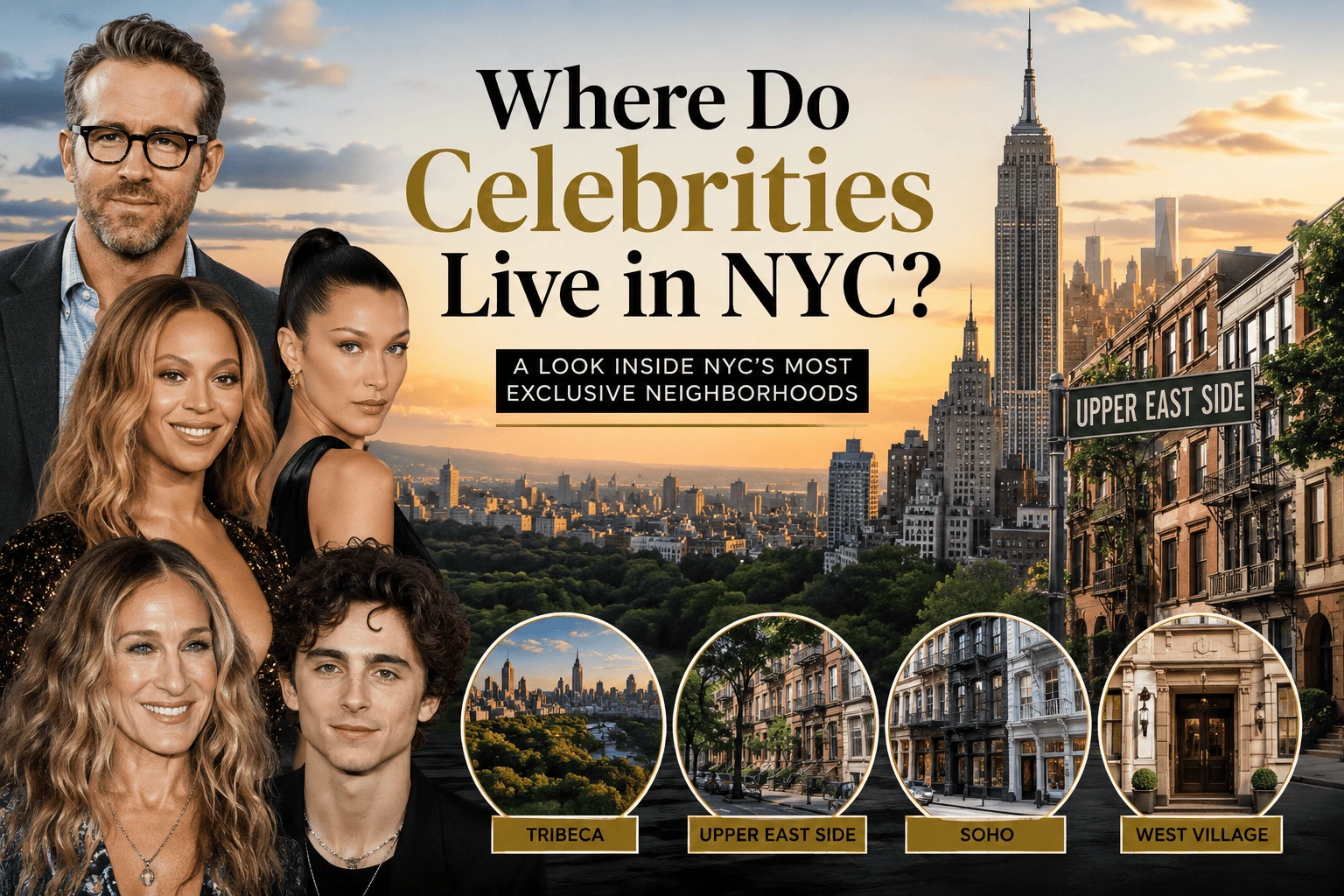
People often ask where do celebrities live in NYC, but the neighborhoods they choose can reveal more about New York’s lifestyle, character, and appeal than celebrity names alone.
These areas are shaped by the things that make them appealing: privacy, location, architecture, access to everyday amenities, and the general feel of the neighborhood. This article stays at the neighborhood level rather than pointing readers toward specific buildings, apartments, or private addresses. Publicly reported celebrity connections also need some context, since a past association does not necessarily mean someone still lives there.
What Makes a New York Neighborhood Attractive to Celebrities?
Privacy matters in a city where being recognized can turn an ordinary trip outside into an interruption. Celebrities may prefer buildings and streets where they can come and go without drawing much attention, while still having the security and services that come with a high-end residential area.
Location matters too. Being close to good restaurants, parks, shopping, entertainment, and cultural spots can make daily life easier without requiring a long trip across the city. The appeal is not always about living in the most famous part of Manhattan. Sometimes it is about having the right mix of convenience and distance from the busiest streets.
The neighborhood itself also plays a role. A historic building, a quiet block, a low-rise street, or a larger loft can offer a very different experience from a newer luxury tower. In Manhattan, that might mean staying close to work and nightlife while finding a residential pocket that feels removed from the crowds.In Brooklyn, the appeal can sometimes lean toward quieter streets, larger homes, and a stronger neighborhood feel.
And a neighborhood with famous residents is still just a neighborhood. People choose these areas for many of the same reasons anyone else does, even if they have more options when it comes to privacy, space, and housing.
The NYC Neighborhoods Most Associated With Celebrities
Some offer classic Manhattan residential life, while others are known for lofts, historic streets, or a quieter pace. Their appeal comes partly from having access to the city without making everyday life feel quite so exposed.
The Upper West Side’s residential character is closely tied to its location near Central Park and its mix of historic apartment buildings and co-ops. Tribeca is more downtown and has a different feel, with spacious loft-style residences and a reputation for attracting people from the film and entertainment world. West Village and Greenwich Village bring a lower-rise, more local atmosphere, while NoHo stands out for its architecture and limited residential stock. Across the East River, Brooklyn Heights offers another version of city living, with brownstones, quieter streets, and easy access to Manhattan.
People move, buildings change hands, and a celebrity connection that was widely reported years ago may no longer describe the area today.
Upper West Side
The Upper West Side has a more established residential character than many of Manhattan’s better-known downtown areas. Its proximity to Central Park is a major part of the appeal, but so are the quieter side streets and the concentration of older residential buildings.
Historic co-ops and prewar architecture give the neighborhood a sense of permanence that newer luxury districts do not always have. It is possible to be close to the park, cultural institutions, restaurants, and the rest of Manhattan while still living in an area that feels distinctly residential.
That combination may help explain the neighborhood’s association with celebrity residents.
Tribeca
Tribeca offers a very different version of Manhattan residential life. Its converted lofts and larger residences give the neighborhood a more spacious feel, while the streets themselves are generally less hectic than the tourist-heavy parts of downtown. You can be in Lower Manhattan without feeling as though you are living in the middle of its busiest activity.
Tribeca NYC has been publicly associated with people in film, television, and music. The neighborhood’s upscale housing fits residents who want plenty of space without giving up a central location, and its relatively quiet streets add to that appeal.
West Village and Greenwich Village
West Village has a more intimate feel, with narrow, walkable streets, historic homes, small restaurants, and blocks that can feel surprisingly removed from the larger city around them. Its low-rise character gives it a residential quality even though downtown Manhattan is close by.
Greenwich Village shares much of that history and cultural identity, but its streets and buildings give it a somewhat different feel. Both neighborhoods have long attracted creative and public figures, though their appeal does not depend on celebrity residents. For someone trying to stay connected to downtown while blending into an ordinary neighborhood setting, that distinction matters.
NoHo
NoHo is smaller and more distinctive, with historic cast-iron buildings and a limited amount of residential space. Its architecture gives the neighborhood a character that is hard to replicate elsewhere in downtown Manhattan, particularly around the loft-style homes that have become part of its identity.
It sits close to SoHo, Greenwich Village, and other parts of downtown, so residents can stay near some of the city’s most active areas without living in a neighborhood dominated by large residential towers. That combination of historic buildings, high-end homes, and fashionable surroundings is part of the neighborhood’s appeal, while its celebrity connections do not make it a dedicated celebrity enclave.
Brooklyn Heights
Brooklyn Heights brings a different setting to the list. Its historic brownstones, tree-lined streets, and quieter blocks give it a more traditional residential feel, while the waterfront and views toward Manhattan keep the city close.
The neighborhood also offers straightforward access to downtown Manhattan without having the same atmosphere as some better-known celebrity-associated neighborhoods. That makes it appealing for people who want a neighborhood with its own identity rather than a purely Manhattan lifestyle..
Celebrity Neighborhoods vs. Specific Buildings: Why the Difference Matters
A neighborhood can have a long list of celebrity associations without any one building being home to a celebrity today. A person may have lived there years ago, sold an apartment, or simply been linked to the area through a widely reported property.
That matters because famous New York buildings often stay in the public conversation long after their residents have moved on. A former residence can easily get repeated as though it were a current one, especially when the original report is old or the date is left out.
Residence claims are more useful when considered alongside the date they were reported and the source of the information. Neighborhood-level information is also more useful for understanding the city’s residential patterns without turning a general guide into a list of private addresses.
What These Neighborhoods Are Actually Like for Ordinary Visitors and Residents
Away from the celebrity associations, these neighborhoods offer fairly different versions of everyday New York. The Upper West Side has a more traditional residential rhythm, with parks, local businesses, and established apartment buildings. Tribeca feels quieter and more spacious, while the West Village and Greenwich Village are more intimate and street-oriented.
NoHo is compact and strongly shaped by its historic architecture. Brooklyn Heights feels more residential again, with brownstones, quieter blocks, waterfront access, and views across to Manhattan. Transportation and walkability vary somewhat between them, but all keep residents within easy reach of the wider city.
For visitors, the appeal is usually the neighborhood itself rather than the possibility of seeing someone famous. Restaurants, parks, shops, architecture, and the simple experience of walking the streets tend to give a better sense of why these places remain interesting.
Frequently Asked Questions
Which NYC neighborhoods are most commonly associated with celebrities?
The Upper West Side, Tribeca, West Village, Greenwich Village, NoHo, and Brooklyn Heights are among the NYC neighborhoods commonly associated with celebrity residents. That does not mean they are exclusively celebrity areas or that every reported connection is still current.
Are the Upper West Side and Tribeca still considered celebrity-associated areas?
Yes. Both have a long-standing public association with celebrity residents, although individual people and properties change over time. The neighborhoods themselves remain relevant because of the type of housing and lifestyle they offer.
Do celebrities live in Brooklyn too?
Yes. Brooklyn Heights is one example of a Brooklyn neighborhood that has had celebrity connections. More broadly, some public figures choose Brooklyn for its residential feel while remaining close to Manhattan.
Does a celebrity connection mean they still live in that neighborhood?
Not necessarily. A celebrity may have moved, sold a property, or simply been associated with the area in an older report. The date of the information matters.
Why is privacy important for celebrities in NYC?
Living in a neighborhood where daily routines can feel less exposed can make a difference. Access to private entrances, quieter streets, and residential buildings can be more useful than simply choosing the most famous address.
Can visitors see celebrity homes or apartment buildings?
Visitors can explore the neighborhoods themselves, but private residences are different. A neighborhood’s streets, parks, shops, and public spaces are appropriate places to experience the area without seeking out someone’s current home.
What should you check before treating celebrity residence information as current?
Look at when the information was published and whether it refers to a current residence or a former one. Recent, credible reporting is more useful than an undated celebrity-home list that may have been copied from older sources.
What to Keep in Mind
If you’re wondering where do celebrities live in NYC, the answer is not limited to one neighborhood. Different people can prefer very different areas depending on their lifestyle, work, space needs, and level of privacy.
Neighborhood-level information gives you a useful picture without turning the subject into a list of private residences. It also holds up better over time, since people move and properties change hands.
Lists of famous residents can be useful for understanding a neighborhood’s history, but they are not necessarily a snapshot of who lives there today.
Its character, location, architecture, and everyday rhythm tell you more about why people choose to live there than a list of famous names does.