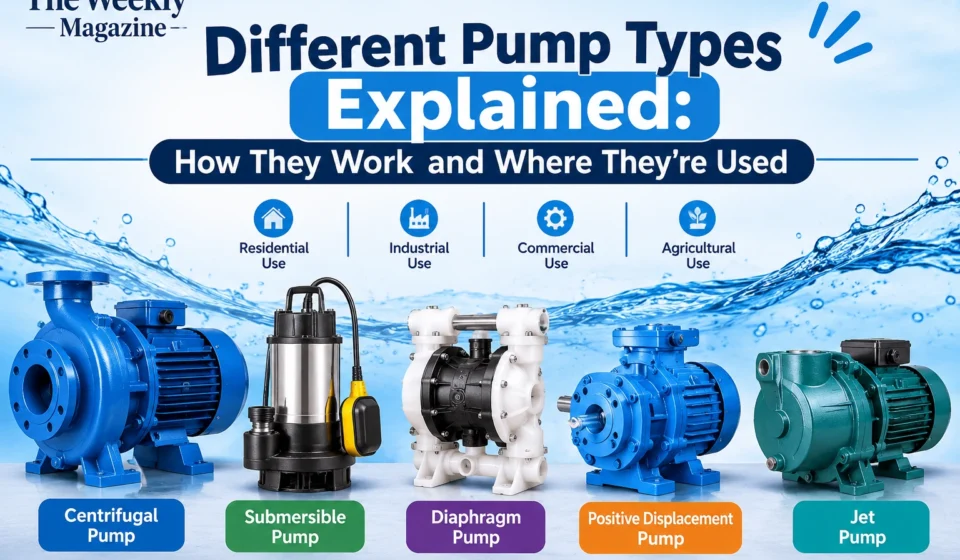

Different pump types are used to move liquids through systems in homes, farms, construction sites, and industrial facilities. The right pump depends on the liquid being handled and the flow and pressure the system requires. A pump designed to move large volumes of water, for example, may not perform well with thick oil or certain chemical fluids.
Each pump design works differently and produces its own flow characteristics and pressure levels. Centrifugal and positive displacement pumps are two major categories, each with specific strengths and limitations. Understanding how they differ helps explain why a pump suited to one application may not work well in another.
This article explains how different pump types work, where they are commonly used, and what sets their designs apart. It focuses on centrifugal and positive displacement pumps while also covering other common designs, along with the key factors to consider when choosing a pump, including liquid properties, required flow rate, pressure, and installation conditions.
What Is a Pump?
A pump is a mechanical device that moves liquid from one place to another by adding energy to it. That energy helps the liquid travel through pipes, overcome resistance, or reach a higher point in a system. Pumps are commonly used for water, oil, fuel, chemicals, and other fluids.
Most pumps receive mechanical energy from an electric motor or an engine and transfer it to the liquid as hydraulic energy. The exact process depends on the pump design. Some use a rotating impeller to increase the liquid’s velocity, while others trap a set amount of liquid and push it toward the outlet.
The main components vary between designs, but a typical motor-driven pump may include a motor, shaft, casing, inlet, and outlet. In a centrifugal pump, the impeller sits inside the casing and helps move the liquid. The shaft transfers rotation from the motor to the impeller. Not every pump uses an impeller, though; piston, gear, and diaphragm pumps work differently.
A few basic terms help explain what happens as liquid moves through a pump:
- Suction: The process of drawing liquid into the pump through its inlet. The pump creates a pressure difference that allows liquid to move from the source into the inlet; it does not draw liquid in by creating a perfect vacuum.
- Discharge: The point where the pump sends liquid out into the connected pipe or system.
- Flow rate: The volume of liquid the pump moves over a given period, commonly measured in gallons per minute (GPM) in the United States.
- Pressure: The force per unit area exerted by the liquid. Pump systems also use head to describe the energy added to the liquid, expressed as the height of a liquid column.
These terms describe different parts of pump performance. A high flow rate does not automatically mean high pressure, and the pressure a pump can develop depends on its design and operating conditions.
Dynamic and positive displacement describe two different ways pumps move liquid, rather than two descriptions of the same classification level. Their differences become clearer when looking at the pump types individually.
The Two Main Pump Categories and How They Differ
Most pumps fall into one of two broad groups: dynamic pumps and positive displacement pumps. The main difference is how they transfer energy to the liquid. Dynamic pumps increase the liquid’s velocity and convert part of that energy into pressure. Positive displacement pumps move liquid by capturing a defined volume and forcing it toward the discharge side.
Dynamic pumps generally produce a continuous flow while the impeller or other moving element keeps operating. Their output changes with system resistance, so a change in discharge pressure can affect how much liquid the pump delivers. Centrifugal pumps are the most familiar example of this design.
Positive displacement pumps work differently. Their moving parts trap liquid in a chamber or space, then push it toward the outlet. The volume moved per cycle or rotation stays relatively consistent, although actual output can vary with speed, leakage, and operating conditions. Gear, piston, diaphragm, screw, and lobe pumps belong to this group.
The difference matters when choosing a pump for a particular liquid or system. Dynamic pumps are often a practical choice for moving large volumes of relatively low-viscosity liquids. Positive displacement pumps are commonly used when a system needs controlled delivery, handles thicker fluids, or requires high pressure at a relatively steady flow.
Neither category is automatically better. A pump that handles water efficiently may struggle with a thick fluid, while a positive displacement design can create dangerous pressure if its discharge line becomes blocked. The operating conditions matter as much as the category.
Centrifugal Pumps and Their Common Variations
Centrifugal pumps are widely used because they can move large amounts of liquid through a relatively straightforward design. They use a rotating impeller to increase the liquid’s velocity, then rely on the pump casing to convert much of that velocity into pressure.
Liquid enters through the suction inlet near the center of the impeller. As the impeller rotates, its vanes move the liquid outward toward the casing. The liquid gains velocity during this movement. Inside the casing, the flow passage slows the liquid down and helps build pressure before it leaves through the discharge outlet.
This design works well in water supply systems, irrigation networks, HVAC equipment, construction projects, and many industrial fluid-transfer operations. Unlike positive displacement pumps, centrifugal pumps generally provide a continuous flow rather than delivering a defined volume with each rotation.
They do have limits. Thick liquids create more resistance inside the pump and can reduce its performance. Most standard centrifugal pumps also need to be filled with liquid before operation, unless they are designed for self-priming. Running one dry can damage its mechanical seal. Suction conditions matter too; insufficient inlet pressure can cause cavitation, which may damage the impeller and create noise and vibration.
Single-Stage and Multistage Centrifugal Pumps
The number of impellers inside a centrifugal pump affects how much pressure it can develop. A single-stage pump has one impeller, while a multistage pump uses two or more impellers arranged in sequence. As liquid passes through each stage, more energy is added to it.
Single-stage pumps are common where moderate pressure and a useful flow rate are enough. Their simpler construction can also make inspection and servicing less complicated.
Multistage pumps are used when liquid needs to reach higher pressures. They are common in high-rise building water systems, boiler feed applications, and pressure-boosting installations. Adding stages increases the pressure the pump can develop, but it does not automatically make the pump suitable for every high-flow application.
Horizontal and Vertical Centrifugal Pumps
Horizontal and vertical centrifugal pumps differ mainly in how the pump shaft and assembly are positioned. In a horizontal design, the shaft runs horizontally. In a vertical design, it runs vertically, which changes the pump’s footprint and how it fits into an installation.
Horizontal pumps are common in industrial facilities and building service systems where floor space and maintenance access allow for a conventional layout. Their components are often easier to reach, although the actual access depends on the installation.
Depending on the design, vertical pumps can be useful where floor space is limited or liquid must be drawn from a sump, tank, or deep source. Some vertical designs are installed with the pump submerged while the motor remains above the liquid. Water treatment facilities and industrial plants use these arrangements when the layout calls for them.
The choice is not simply about which orientation takes up less room. Maintenance access, liquid level, foundation requirements, and the available installation space all affect which arrangement makes sense.
Positive Displacement Pumps and Their Main Types
Positive displacement pumps are useful when a system needs a more controlled delivery of liquid, particularly when the fluid is too thick for a standard centrifugal pump to handle efficiently. Their output is closely related to the pump’s operating speed, which makes them suitable for applications where a relatively consistent amount of liquid needs to be delivered.
These pumps also work well in high-pressure systems. Their ability to maintain delivery against substantial resistance makes them common in hydraulic equipment, chemical processing, and industrial fluid handling. The actual pressure capability depends on the pump design, materials, and drive system.
If a valve closes or a pipe becomes blocked while the pump continues running, pressure can rise quickly. This can damage the pump, pipes, seals, or other system components. Positive displacement systems that could develop excessive pressure require an appropriate overpressure protection arrangement.
Gear Pumps
A gear pump uses two rotating gears to move liquid through its casing. As the gears turn, liquid becomes trapped in the spaces between the gear teeth and the pump housing. It travels around the outer edges of the gears toward the discharge side, where the teeth come back into contact and push the liquid out.
External gear pumps use two separate gears that mesh with each other. Internal gear pumps have a smaller gear rotating inside a larger ring-shaped gear. Both designs transfer liquid through gear movement, but their construction and operating characteristics differ.
Gear pumps are commonly found in hydraulic systems, lubrication equipment, and fuel-transfer applications. They can handle oils and other relatively thick liquids, making them useful where a steady supply of fluid is needed.
Their close-fitting internal parts are also a limitation. Abrasive particles can wear the gear surfaces and housing, reducing efficiency and shortening service life. The liquid should be compatible with the pump materials and sufficiently clean for the selected design.
Piston and Plunger Pumps
Piston and plunger pumps use a reciprocating motion to move liquid. A piston or plunger moves back and forth inside a cylinder, changing the available chamber volume. Valves control the direction of liquid movement during each stroke, allowing the pump to draw liquid in and then force it out.
The main difference is how the moving part fits and seals inside the cylinder. A piston pump uses a piston fitted with seals that move along the cylinder wall. In a plunger pump, the plunger passes through a stationary seal, while the cylinder chamber remains around it. This arrangement makes plunger pumps particularly suitable for many high-pressure applications.
These pumps are used in pressure-washing equipment, water treatment systems, chemical dosing, and industrial processes that require high discharge pressure. Their performance makes them useful when a system needs more than the moderate pressure available from many standard pumping arrangements.
Because the pumping action is reciprocating, the output can rise and fall with each stroke. This pulsation may need to be controlled with a pulsation dampener, depending on the application. Valves, seals, and other moving parts also need regular inspection because wear can affect both performance and leakage.
Diaphragm Pumps
Diaphragm pumps use a flexible membrane that moves back and forth inside a chamber. As the diaphragm moves away from the chamber, liquid enters through an inlet valve. When it moves in the opposite direction, the liquid is pushed through the outlet valve.
The diaphragm separates the pumped liquid from the mechanical drive components. This helps reduce the chance of fluid reaching parts that could be damaged by corrosive or contaminated liquids. It also makes diaphragm pumps useful for handling certain chemicals, wastewater, slurries, and sensitive fluids.
Some air-operated diaphragm pump designs can run dry for limited periods without the same damage risk associated with many other pump types. This depends on the pump construction and operating conditions, so dry-running capability should always be checked against the manufacturer’s specifications.
The diaphragm itself is a wear component. Repeated flexing, chemical incompatibility, excessive pressure, or abrasive material can cause it to deteriorate or fail. Choosing a diaphragm material suited to the liquid is important, particularly when handling aggressive chemicals.
Screw and Lobe Pumps
Screw and lobe pumps are rotary positive displacement designs often used when a process needs a smooth, relatively continuous supply of liquid. They can handle many viscous fluids, but their internal arrangements make them suitable for different types of service.
A screw pump moves liquid along the length of rotating screws. The screws create spaces that carry the liquid from the inlet toward the outlet. Depending on the design, these pumps can provide low-pulsation flow and are used in oil transfer, industrial processing, and other applications involving viscous fluids.
A common synchronized lobe pump uses two or more rotating lobes that do not make direct contact. Liquid moves through the spaces between the lobes and the pump casing. These pumps are widely used in food processing and pharmaceutical production, where gentle product handling and the ability to clean the pump are important.
The choice between the two depends on the liquid and the process. Lobe pumps are often selected for products that need careful handling or frequent cleaning, while screw pumps are common in applications that benefit from smooth transfer of oils and other viscous fluids. Neither design is suitable for every particle-containing liquid. Clearances, particle size, product sensitivity, and cleaning requirements all need to be considered.
How Different Pump Types Compare in Real-World Applications
The right pump depends on what the system needs to move and the conditions under which it operates. A household water supply system, for example, usually needs a dependable flow at a usable pressure. A centrifugal pump can meet household water supply needs when paired with an appropriate pressure system. The pump handles water movement, while the pressure system helps maintain delivery as household demand changes.
Deep borewells require a different arrangement. Submersible pumps are commonly used because they operate below the water level and push water toward the surface. Jet pumps can also draw groundwater, but their practical suction limits make them more suitable for shallower wells. Well depth, water level, and required delivery all affect which arrangement will work.
Thick oil and other viscous liquids call for pumps designed to handle greater resistance. Gear pumps are often used for lubricating oils and fuel, while screw pumps suit many oil-transfer and industrial applications that need smooth delivery. Lobe pumps are useful when product handling and cleaning requirements matter, including some food and pharmaceutical processes. The liquid’s viscosity and any particles it contains help determine which design is appropriate.
Chemical transfer and dosing need careful attention to material compatibility and delivery control. Diaphragm pumps are common in chemical processing because suitable models can isolate the liquid from the drive mechanism. Peristaltic pumps move liquid through flexible tubing, keeping it away from most pump components. This can be useful for corrosive fluids or applications where contamination needs to be limited, provided the tubing is compatible with the chemical.
High-pressure industrial work may call for piston or plunger pumps, particularly when the system needs high pressure with controlled delivery. Multistage centrifugal pumps are another option when a continuous supply is needed at higher pressure. Flow, pressure, and liquid properties all affect the choice.
Construction and drainage projects bring different demands. A pump may need to move large volumes quickly, handle suspended solids, or operate at changing water levels. Portable trash pumps and suitable submersible drainage pumps are often used for these jobs. A standard water pump may not cope with debris or solids, so the size of particles and the pump’s solids-handling capacity need to be checked before installation.
Key Factors in Pump Selection
Choosing a pump starts with the liquid itself. Water, fuel, oil, chemicals, and wastewater place different demands on pump materials and internal components. Viscosity affects how easily a liquid moves, while temperature can change its behavior and affect seals. Corrosive fluids may require special casing materials, and liquids containing solids need a design that can pass those particles without excessive wear or blockage.
The system’s required flow rate should be established before comparing pump models. It is commonly measured in gallons per minute (GPM) or liters per minute (LPM). The pump must meet the demand without being unnecessarily oversized, since a pump operating far from its intended conditions can waste energy and create operating problems.
Total Dynamic Head (TDH) is another important part of the calculation. It accounts for the vertical lift, pressure requirements, and losses caused by friction as liquid travels through pipes, fittings, and valves. Suction lift and discharge conditions also affect the pump’s ability to deliver the required performance. Selecting a pump based only on the height of the building or well can lead to an incorrect choice if other system losses are ignored.
Materials and construction need to suit both the liquid and the installation environment. The casing, impeller, seals, and gaskets should tolerate the fluid’s chemical properties and operating temperature. A material that works well with clean water may not last when exposed to an aggressive chemical or abrasive mixture.
Available power requirements may affect which pump can be installed. Check the motor rating against the pump’s expected operating load, then consider available electricity, voltage, phase, or fuel supply. Energy use over the pump’s working life can have a greater effect on total cost than the initial purchase price.
Installation space and maintenance access can also narrow the options. A pump that fits the required performance specifications may still be impractical if there is not enough room to remove components or service the motor. Compare the purchase price with expected maintenance, replacement parts, energy consumption, and the cost of downtime.
Understanding Pump Performance Specifications
A pump’s specifications show what it can deliver under stated operating conditions. The rated flow and head are useful starting points, but they should not be treated as guaranteed performance at every operating condition. A pump may deliver a different flow when pipe resistance, liquid properties, or system pressure changes.
Pump curves help show how performance changes across a range of operating conditions. A centrifugal pump curve typically plots flow against head, with additional curves sometimes showing efficiency, power demand, and NPSH required. The point where the pump curve meets the system curve represents the operating point. This is the flow and head the pump is expected to produce in that particular system.
Horsepower describes the motor’s power rating, but a higher horsepower number does not automatically mean a pump will deliver more useful flow or head. The pump’s design, impeller size, speed, and operating point all affect its performance. The motor must have enough power for the load the pump will actually experience, with the manufacturer’s recommended limits taken into account.
Efficiency indicates how much of the input power is converted into useful hydraulic output. Centrifugal pumps have a Best Efficiency Point (BEP), where they operate most efficiently for a given configuration and speed. Running too far from this point can increase energy use, vibration, and mechanical stress, which may shorten equipment life.
Net Positive Suction Head (NPSH) is important when checking whether liquid can enter the pump without vapor bubbles forming. NPSH available (NPSHa) describes the suction conditions provided by the system, while NPSH required (NPSHr) is the minimum level specified by the pump manufacturer for a given operating condition. NPSHa should exceed NPSHr by an appropriate margin. If the available suction head is insufficient, cavitation can occur and damage internal components.
Common Pump Performance Issues
Pump performance can change over time, even when the equipment was suitable for the system at installation. Some problems develop gradually through wear, while others appear after a change in operating conditions or an installation mistake.
Cavitation is one issue worth taking seriously. It can occur when the pressure at the pump inlet falls too low, allowing vapor bubbles to form in the liquid. When these bubbles collapse, they can create noise, vibration, and damage to the impeller surface. A rattling sound, reduced flow, or unexpected vibration may indicate cavitation, although these symptoms can have other causes too.
Priming problems can also prevent a pump from delivering liquid properly. Many centrifugal pumps need their casing and suction line filled before startup. If air remains trapped inside, or air enters through a loose connection or damaged seal, the pump may struggle to establish suction. A drop in flow or a pump that runs without delivering liquid can point to this problem.
Overheating, unusual noise, and excessive vibration are other warning signs. They may result from misalignment, worn bearings, an obstructed inlet, incorrect installation, or operation outside the pump’s intended range. Seal leakage can indicate worn sealing surfaces or damage, while a rough running sound may suggest bearing wear or impeller problems. These signs should be checked rather than ignored, since continued operation can lead to more expensive repairs.
Some operating mistakes can cause damage quickly. Dry running may overheat seals and other internal parts, particularly in pumps that rely on the liquid for cooling or lubrication. A blocked discharge can create dangerous pressure in a positive displacement pump, while incorrect pipe sizing or poor installation can increase resistance and strain the equipment.
Routine inspection helps catch these problems before they cause a major failure. Check for leaks, unusual noise, vibration, temperature changes, and reduced output. Follow the manufacturer’s guidance for lubrication, seal inspection, cleaning, and replacement intervals. The maintenance schedule should also reflect how often the pump runs and the conditions it handles.
Frequently Asked Questions
What are the two main categories of pumps?
Dynamic and positive displacement classify pumps by how they move liquid; submersible pumps are identified by operating below the liquid level, while jet pumps use a jet of fluid to help draw water. Dynamic pumps transfer energy by increasing liquid velocity, while positive displacement pumps move liquid through a defined volume during each cycle or rotation.
Which pump type is best for high-viscosity liquids?
Gear, screw, and lobe pumps are commonly used for high-viscosity liquids. The right choice depends on how thick the liquid is, whether it contains particles, and how carefully it needs to be handled.
What is the difference between a centrifugal and a positive displacement pump?
A centrifugal pump uses an impeller to increase liquid velocity and develop pressure. A positive displacement pump moves liquid through a chamber or space and generally provides a more consistent volume per cycle or rotation. Their performance differs under changing system conditions.
Which pump is suitable for deep borewells?
A submersible pump is commonly used for deep borewells because it operates below the water level and pushes water to the surface. The required pump capacity depends on the well depth, water level, and delivery demand.
Can centrifugal pumps handle chemicals?
Yes, some centrifugal pumps are designed to handle chemicals. The casing, impeller, seals, and other wetted parts must be compatible with the specific chemical and its concentration and temperature. A standard water pump should not be assumed suitable for chemical transfer.
What is the difference between a submersible pump and a regular water pump?
A submersible pump is designed to operate while immersed in the liquid it moves. Many conventional water pumps remain outside the liquid and draw it through a suction line. The suitable arrangement depends on the water source, installation depth, and system requirements.
Does a higher horsepower pump always provide better performance?
No. Horsepower alone does not determine whether a pump is suitable. Flow, head, efficiency, pump design, and the system’s operating conditions all matter. An oversized pump can consume more energy than necessary and may operate poorly if it is not matched to the system.
Final Thoughts
Different pump types serve different purposes, and choosing between them starts with understanding what the system actually needs. The pump’s design should suit the liquid being moved and the pressure and flow the application requires.
Flow rate, total head, operating conditions, and material compatibility deserve attention before comparing models. Specifications and efficiency also matter, particularly when the pump will run for long periods or operate under demanding conditions. Maintenance requirements should be part of the decision rather than something considered after installation.
The right pump is not necessarily the most powerful or expensive option. It is the one that delivers the required performance reliably, handles the liquid safely, and fits the conditions in which it will operate.