
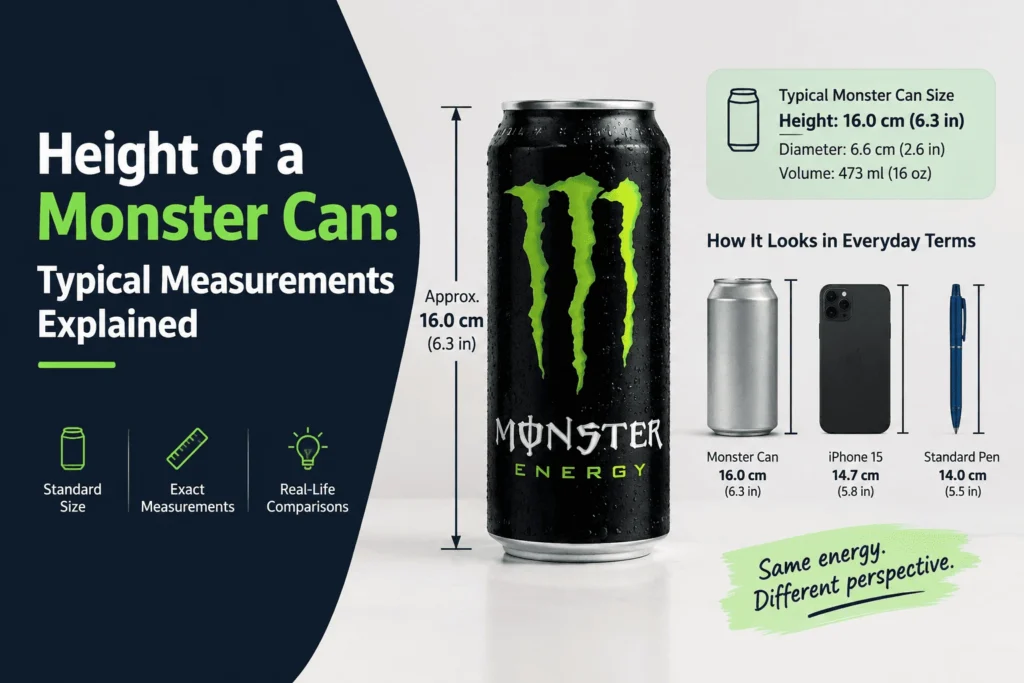
A typical Height of a Monster Can is about 6.2 inches tall, or roughly 15.7 cm, when you’re talking about the familiar U.S. 16 fl oz format.
That number is useful, but it does not describe every Monster can. The brand sells different capacities and packaging formats, so the physical height can change with the can design.
The distinction matters because 16 fl oz or 473 mL tells you how much drink the can holds. It does not, by itself, tell you how tall the container is. The rest of the measurements depend on the actual can format.
How Tall Is a Typical Monster Can?
The standard U.S. 16 fl oz height of a Monster can is commonly measured at about 6.19 inches in height, or 15.72 cm. It is commonly rounded to 6.2 inches or 15.7 cm for everyday measurements.
Here, height refers to the full outside vertical measurement of the can from bottom to top. It is the full outside measurement of the container, not just the straight side of the aluminum body.
This is the useful reference point for the familiar 16 fl oz can, not a universal Monster measurement. Other sizes and regional formats can use different can bodies.
Why Monster Can Height Can Vary
Monster cans come in more than one capacity and format. Monster’s U.S. Original Green lineup, for example, includes 12, 16, 19.2, and 24 fl oz sizes.
A larger capacity does not automatically mean the can gets taller by a fixed amount. The manufacturer can change the height, diameter, or overall proportions of the container to hold more liquid.
Market differences matter too. That is why the printed volume should be treated as one detail, while the actual can dimensions are checked separately.
Common Monster can sizes can have different physical heights, depending on the format
The 16 fl oz can gives a reference point, while smaller and larger Monster formats can have different physical heights. Those cans do not simply scale up or down in height. A change in capacity can come with a different can diameter or a different overall proportion.
A size comparison is clearer when capacity and physical height are kept separate. A 500 mL can, for instance, should be checked by its actual dimensions rather than assuming its height from the volume alone.
Larger formats may require more physical space, with the difference appearing in height, width, or both. If the can has to fit somewhere specific, the stated dimensions for that particular format are the numbers that matter.
How Big Is a Monster Can in Everyday Space?
A can that is around 6 inches tall can fit easily on some refrigerator shelves while running into trouble on a shelf with limited clearance. The difference can be surprisingly small when the available space is already tight.
Cup holders are a separate issue. Height tells you whether the can reaches above the holder, but the holder’s opening determines whether the can actually sits inside it securely.
The same applies to racks, cabinets, and display spaces. Measure the usable vertical clearance rather than the space you can see at a glance. A few fractions of an inch can matter when the fit is tight.
A familiar object can help you picture the height, but it should not replace the can’s stated measurement when the fit needs to be precise.
Height vs. Other Monster Can Dimensions
Height is only one part of a can’s physical size. Width, or diameter, affects how much horizontal space the can takes up, while height determines the vertical clearance it needs.
That matters when a can has to fit inside something rather than simply stand on a shelf. A narrow space may have plenty of height but still be too tight across. A shallow shelf can have enough width and still not leave enough room above the can.
Can formats also change their proportions. Two cans can hold similar amounts while having slightly different height-to-width relationships. So if you’re checking whether a Monster can will fit, height alone gives you only part of the answer.
What to Check Before Using a Monster Can in a Specific Space
Start with the usable vertical clearance and compare it with the can’s stated height. The space needs to allow for the full height of the can, not just most of it.
For a shelf, holder, or rack, measure the actual space inside it rather than relying on how much room appears to be available. This matters more when the fit is close.
It also helps to identify the exact can size and format before using a before assuming the usual size. A different format can change the dimensions enough to affect the fit.
In a tight space, check the can’s width as well as its height. The opening and the room needed to place or remove the can can matter too.
Frequently Asked Questions
What is the typical height of a Monster can?
A typical U.S. Monster can is around 6 inches tall, although the exact height depends on the can size and format.
How many inches tall is a Monster can?
The commonly seen can is roughly 6 inches tall. Other Monster can sizes can have different physical dimensions.
How tall is a Monster can in centimeters?
A can that is around 6 inches tall is about 15 centimeters in height. The exact measurement can vary by format.
Are all Monster cans the same height?
No. Monster cans are available in different sizes and formats, so their physical height is not always the same.
Does a larger Monster can always become taller?
Not necessarily. A larger can may gain size through height, width, or a change in its overall proportions.
Can height be the same in every market or product format?
No single height applies to every market or format. When available, the stated dimensions for the specific can are more reliable than assuming one standard measurement.
What other can dimension matters besides height?
Width or diameter is the main additional dimension to check. For a tight space, the size of the opening and available clearance can also affect whether the can fits.
What to Keep in Mind
The typical Monster can height is a useful reference, but it should not be treated as a universal measurement.
For an exact fit, verify the size and physical dimensions of the specific can you have. Capacity tells you how much liquid the can holds; it does not by itself tell you how tall or wide the can is.