
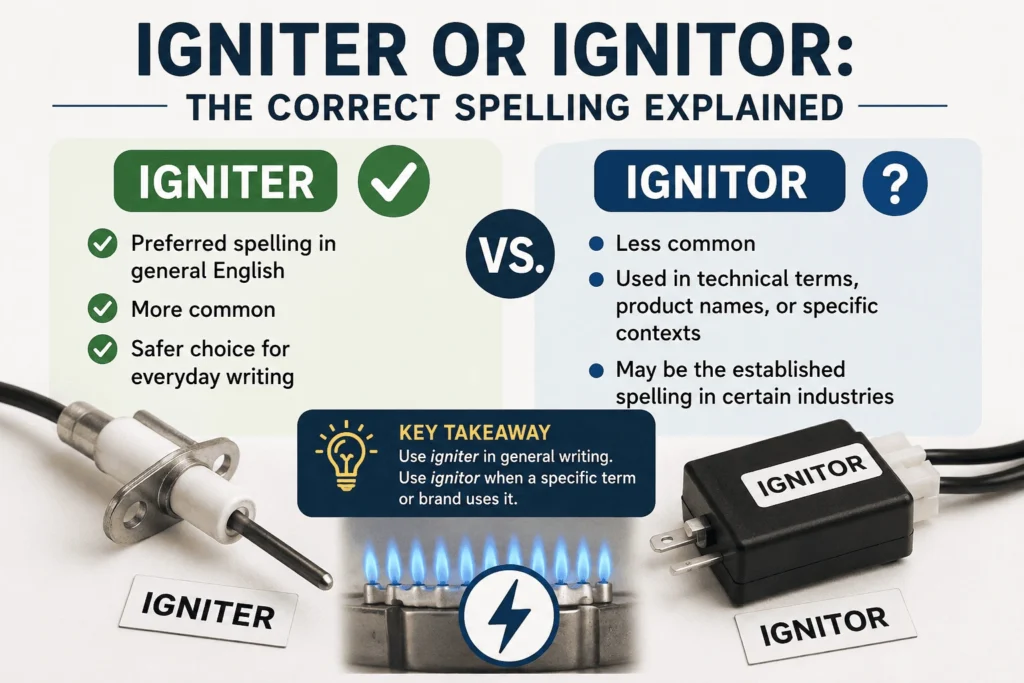
“Igniter” and “ignitor” are both spellings you may come across, but they are not equally common in general English. The choice can look trivial until you need to decide which form belongs in ordinary writing.
Igniter or Ignitor: Which Spelling Is Correct?
For general English, igniter is usually the preferred spelling. It is the form most readers will recognize and the safer choice when you are simply writing about something that starts an ignition process.
Ignitor is also used, though it is generally less common. Its presence does not automatically make it a spelling mistake. You may see it in specific terminology, product documentation, or other contexts where a particular spelling has been established.
In general English usage, the two forms refer to the same basic idea. So the spelling itself does not usually signal a different meaning. If there is no specific terminology to follow, igniter is the straightforward default.
What Do “Igniter” and “Ignitor” Mean?
Both words refer to something that starts an ignition process. In plain terms, an igniter or ignitor is a thing or device used to begin ignition rather than the process of ignition itself.
The words also sit within the same word family as “ignite” and “ignition.” An igniter is a thing or device used to start an ignition process. “Ignitor” follows the same basic meaning, even though the spelling is less common.
You can encounter the word in ordinary descriptions as well as technical contexts. The exact object can vary, but the basic idea stays the same: it initiates ignition.
Why Is “Igniter” the Preferred Spelling?
“Igniter” is more established in general English, which is a big reason it works better as the default spelling. It also follows a familiar pattern in English, where a noun ending in “-er” describes something that acts.
That does not make “ignitor” meaningless or automatically incorrect. A less common spelling can still appear in a particular product or technical term. The useful distinction is between a spelling that is widely preferred and one that is used more narrowly.
When Might You See “Ignitor” Instead?
“Ignitor” can show up in technical or industry-specific terminology where a particular spelling has already been adopted. Product names, manufacturer terminology, manuals, and specifications can preserve that form even when general English favors “igniter.”
That matters when the spelling is part of an established name or technical reference. Changing it just to match the more common spelling could make the reference less accurate.
The rule is fairly simple: general writing can follow the common form, while a specific product or established terminology may call for its original spelling.
Which Spelling Should You Use?
For general English, everyday writing, and ordinary formal writing, use igniter. It is the clearer choice when there is no specific terminology you need to follow.
Technical writing is a little different. Check the terminology used by the relevant industry or the source documentation before changing the spelling. If a product or manufacturer officially uses ignitor, keep that spelling when referring to the specific product or terminology.
Frequently Asked Questions
Is “ignitor” a valid English word?
Yes. “Ignitor” does appear in English usage, although it is less common than “igniter” in general usage.
Do “igniter” and “ignitor” have different meanings?
Generally, no. Both refer to something that initiates ignition.
Should “ignitor” be considered a spelling mistake?
Not automatically. It may be the established spelling in a particular product, technical term, or other specific context.
When is “ignitor” appropriate in technical writing?
Use it when the relevant terminology, documentation, or official name uses that spelling.
Which spelling should I choose if I do not have a specific terminology to follow?
Use igniter. It is the safer general-English choice.
What to Keep in Mind
Remember igniter as the default spelling for general English. “Ignitor” should not be called wrong simply because it is less common.
When a technical, product, or official term has an established spelling, that context takes priority.