
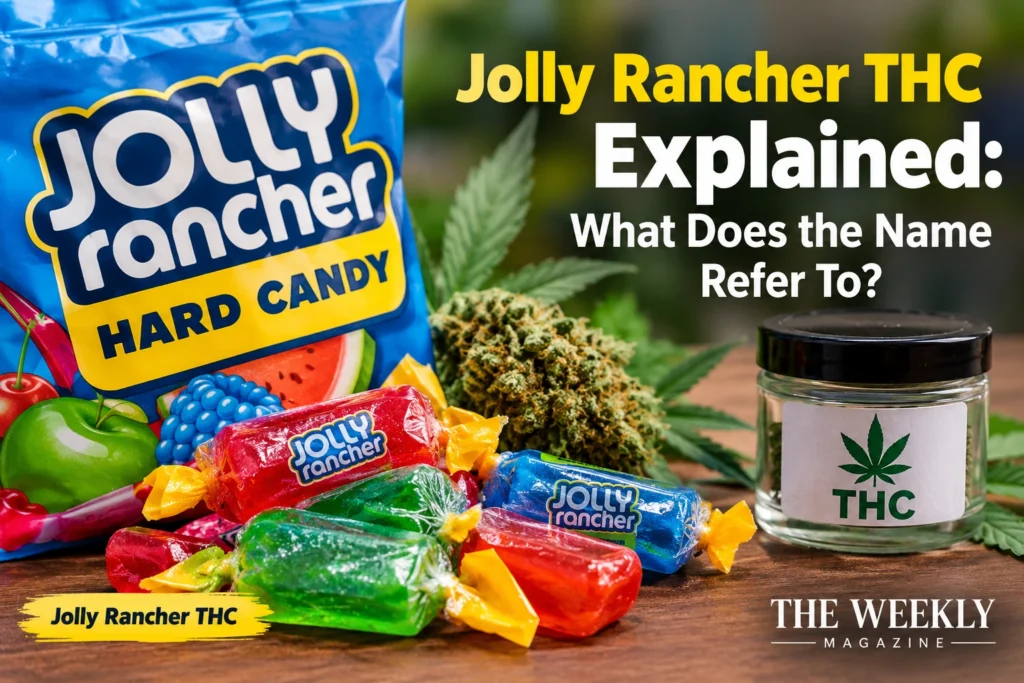
Looking at “Jolly Rancher THC,” it can be difficult to assume right away that it refers to one specific cannabis product. The name may refer to a candy-inspired edible, appear in an informal product description, or be a label on an item that simply looks like familiar branding.
Instead of treating the name as the identity of the product, it is better to consider it a starting point. What the actual product is can be determined more reliably from the label, ingredients, THC amount, manufacturer information, and packaging.
What Does “Jolly Rancher THC” Actually Refer To?
“Jolly Rancher THC” is not the established name of a single standardized cannabis product or strain. This phrase can be used in different contexts, especially for candy-inspired THC edibles or informal descriptions.
“Jolly Rancher” is actually a candy name, so seeing that name on a cannabis product does not prove that the product is an official THC version from the candy brand. The actual identity of the product is established through its labeling and manufacturer information.
If you also come across the name “Jelly Rancher,” do not automatically consider it to be the same product as “Jolly Rancher THC.” Similar-sounding names and candy-style presentation can create confusion, but the exact product becomes clear from the context.
Why the Name Can Be Confusing
The familiar candy name can make a THC product look more official than it actually is. A reader may see the branding and assume there is a direct connection to the candy brand, even when the product is simply using a familiar name or look.
The name also does not tell you how much THC is in the product or what its formulation contains. An online listing can make this harder because sellers, posts, and social media descriptions do not always use product names consistently.
“Jolly Rancher” might describe a candy flavor, the shape of an edible, a homemade product, or branding that has little to do with the original candy company. The name alone leaves too much room for assumption.
How to Tell What Product You Are Actually Looking At
The label is a better place to start. Check the listed THC amount, serving information, ingredients, and product type rather than relying on the name printed on the front.
Look for the manufacturer or producer information as well. Packaging details can help show where the product came from and whether the information on the package is complete.
A candy-like appearance cannot tell you the THC content. Neither can the product name. If the package is sealed and properly labeled, check the required product information instead of treating an informal package as equivalent.
When the identity of the product is still unclear, the information actually printed on the package is the evidence to work from. Guessing based on its appearance can fill in details that simply are not there.
Why Counterfeit or Misleading Packaging Matters
Familiar candy-style packaging can make a product seem more recognizable than it really is. That look may be used on products that are unauthorized, misleading, or simply not connected to the candy brand shown on the package.
The bigger issue is what the packaging cannot reliably tell you. With counterfeit or poorly labeled products, the actual ingredients and THC content may be uncertain, even when the package looks convincing.
It is also important not to treat every cannabinoid product as if it contains THC. Synthetic cannabinoids are different compounds and can have different properties. Calling a product “THC” based only on its appearance or marketing can therefore give the wrong impression about what is actually in it.
An edible with unclear labeling creates the same basic problem. If the ingredients or potency are not clearly established, there is no good reason to fill in those gaps based on the way the product looks.
What the Name Does Not Tell You
“Jolly Rancher THC” does not tell you the exact THC potency. The name can describe what a product is supposed to resemble or how it is marketed without saying anything precise about its cannabinoid content.
It also cannot establish strain genetics, cannabinoid ratios, terpene profile, or expected effects. Those details belong to the actual formulation, not to the candy-inspired name.
The same applies to flavor. A familiar fruit or candy flavor does not tell you how strong a cannabis product is or what cannabinoids it contains. Flavor is mainly a description of the product experience, not a measure of its formulation.
Different products can also use the same descriptive name, which makes the name a poor substitute for identifying the specific product. Marketing language can make an item sound familiar or appealing, but it is the verifiable product information that tells you what you are actually dealing with.
Frequently Asked Questions
What is Jolly Rancher THC?
“Jolly Rancher THC” is not one fixed cannabis product. This phrase can be used depending on the context for a candy-inspired THC edible, cannabis product, or informal product description.
Does Jolly Rancher candy naturally contain THC?
No. Jolly Rancher candy itself is not naturally a THC-containing product. The use of the candy’s name on a THC product does not prove the presence of THC in the candy.
Is “Jolly Rancher THC” the name of a specific cannabis strain?
No, the name does not establish that it is a specific cannabis strain. Strain-related information depends on the actual product and its formulation.
Do Jolly Rancher-style edibles always contain THC?
Not necessarily. A candy-style appearance or flavor does not confirm that an edible contains THC. It is important to look at the actual contents of the product separately from its name and appearance.
How can you confirm how much THC is in a product?
For the THC amount, check the product’s available labeling and listed information. Potency cannot be determined simply from the product’s name, shape, flavor, or appearance.
Can a product be considered genuine just by looking at Jolly Rancher packaging?
No. Familiar packaging is not proof of authenticity. A brand-like appearance and the actual product identity are two different things.
What is the difference between a THC edible and a synthetic cannabinoid product?
It is not accurate to simply call both “THC.” Synthetic cannabinoids are different compounds from THC, so what substance is actually in the product should not be assumed based only on its appearance or marketing.
What is the simplest way to understand this name?
Instead of treating “Jolly Rancher THC” as a fixed product identity, consider it a context-dependent name. The actual product information matters more than the name, especially the ingredients, THC amount, and manufacturer details.
If the identity of the product is not clear, it is better to rely on information that can be verified rather than guessing missing information from familiar branding or flavor.