

“Hydrophilis” looks like a scientific term, but the word itself is not as straightforward as it first appears.If you came across the term while reading about chemistry, biology, medicine, or materials, the surrounding context matters because similar-looking terms can describe slightly different things.
The standard scientific term is hydrophilic. It describes something that has an affinity for water or can interact with water, and the exact behavior can involve mixing, dissolving, wetting, or other forms of interaction.
There is no need to start with complicated molecular theory. The main question is simpler: what does it mean when a substance or surface interacts readily with water?
What Does Hydrophilis Mean?
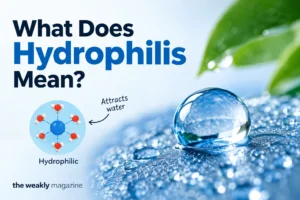

“Hydrophilis” is not the standard English scientific form used in major chemistry references. Hydrophilic is the established term, and For the standard term hydrophilic, IUPAC describes the property in terms of how a molecular entity or substituent interacts with polar solvents, especially water.
So if you see “hydrophilis” in a general discussion, it is important not to automatically treat it as a separate scientific concept. It may be a spelling variation, a mistaken form of hydrophilic, or a term being used in a specific context. The surrounding text can help determine what the writer intended.
Hydrophilic behavior describes a tendency for a substance or surface to interact favorably with water. Depending on what is being discussed, that can show up as easier mixing, dissolution, wetting, or water uptake. These are related behaviors, but they are not identical.
A material can also interact well with water without every part of it dissolving. A surface, for instance, may allow water to spread across it while the material itself remains intact. That is why “hydrophilic” should not be treated as a simple synonym for “water-soluble.”
Why Do Some Substances Interact With Water?
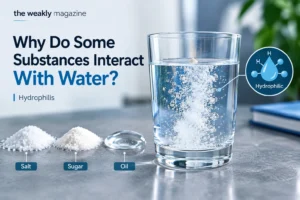

Water has an uneven distribution of electrical charge, which is why it is described as a polar molecule. That polarity gives water a way to interact with other molecules that have polar or charged parts. A substance with those features can form favorable interactions with nearby water molecules, while a substance without them may interact much less readily.
Hydrogen bonding is one possible part of how certain molecules interact with water.
Water interaction should not be reduced to one word. Mixing, wetting, absorption, and dissolving describe different things. A liquid may mix with water, while a solid surface may simply let water spread across it. Another material may take up water without dissolving.
The details depend on the substance’s composition and, for surfaces, what is exposed at the surface. Small changes there can affect how water behaves.
Hydrophilic vs. Hydrophobic: What Is the Difference?
Hydrophilic and hydrophobic describe two different tendencies around water. A hydrophilic substance tends to interact favorably with water. A hydrophobic substance tends to avoid interaction with water and may cause water to gather into droplets instead of spreading out.
Oil and water make the difference easy to see. They separate rather than forming one uniform mixture, which is why a layer of oil can sit above water. The behavior is not simply about one liquid being “wet” and the other being “dry.” Their molecular properties do not favor the same kind of interaction with water.
The distinction also matters when looking at a surface. On a more hydrophilic surface, water generally tends to spread more readily. On a more hydrophobic surface, it tends to pull into a rounded droplet. The contact between water and the surface is revealing something about how those two interact.
That does not mean a hydrophilic material will always dissolve in water. A material can have water-friendly surfaces or parts while remaining physically intact. The behavior being observed has to be identified before giving it a label.
What Are Some Everyday Examples of Hydrophilic Behavior?
Salt and sugar provide familiar examples of substances that interact readily with water. When added to water, both can disperse and dissolve rather than remaining separate. The important point here is not just that they disappear into the water, but that their interaction with water is strong enough to support that process.
Paper and cotton show a different kind of behavior. They can become wet and take up water without simply dissolving. Some fabrics behave similarly, although their exact behavior depends on the material and how the fabric has been treated. That water interaction can involve absorption or wetting rather than complete dissolution.
Soap and detergent contain water-interacting parts within structures that also include other types of parts. Their structures contain water-compatible portions that help them work in mixtures involving water, while other parts interact with substances that water does not handle as easily.
Plants provide another familiar setting. Water moves through plant tissues and interacts with many biological materials along the way. Similar water interactions are important throughout living systems, where molecules and structures often need to function in environments that contain a lot of water.
Looking at these situations makes the property easier to recognize. The visible result might be dissolving, soaking, spreading, or simply becoming wet, depending on what material is involved.
Where Does Hydrophilic Behavior Matter?
Hydrophilic behavior matters because water is involved in so many biological and practical processes. In biology, water-interacting molecules and cell-related structures help support processes that take place in watery environments. The property is therefore part of how many biological materials behave and function.
Medicine and pharmaceutical formulations provide a more controlled use of the same idea. Water compatibility can affect how an ingredient is prepared, carried, or distributed in a formulation. The useful behavior depends on what the formulation is designed to do, so there is no single result that applies to every product.
Cosmetics, cleaning products, and other everyday formulations also make use of materials that interact with water. Whether the goal is spreading, blending, cleansing, or keeping ingredients in a workable mixture, water interaction can affect how the final product behaves.
Materials and surfaces are another area where it matters. A surface that interacts readily with water may be easier to wet or coat, which can be useful when a material needs to work with a water-based substance.
The practical meaning of hydrophilic behavior therefore changes with the setting. A property that matters for a biological molecule may be used differently from the same general water interaction in a surface, formulation, or household product.
Common Confusions About Hydrophilis
One common shortcut is to describe hydrophilic materials as simply “water loving.” The phrase can help at the beginning, but it can also make the idea sound more absolute than it is. Hydrophilic behavior is about how something interacts with water, and that interaction can take different forms.
It is also easy to treat hydrophilic and hydrophobic as fixed labels that explain everything about a material. Actual behavior depends on what part of the material is exposed and what property is being observed. A substance can contain both water-compatible and less water-compatible parts, so one label may not describe every part equally well.
Assuming that attraction to water automatically means complete solubility. A material may interact strongly with water while remaining intact. The same problem appears when one hydrophilic part is used to describe an entire substance as completely water-soluble. Its different parts can behave differently.
The word “hydrophilis” itself also deserves some care. Since hydrophilic is the standard scientific term, an unfamiliar spelling should be checked against its context rather than automatically treated as a separate concept. That small distinction can prevent a basic terminology issue from turning into a misunderstanding of the science.
How to Recognize Hydrophilic Behavior
Everyday observation can give you a useful starting point. Watch what happens when water comes into contact with a material. Does it spread, mix, wet the surface, or get taken up by the material? These observations can suggest how the material is interacting with water.
Water droplets can make surface behavior especially easy to notice. The way a droplet sits, spreads, or pulls into a more rounded shape can provide a clue about the surface. But the visible shape alone does not tell you everything about the material.
Composition matters, as do the properties of the surface being observed. A coating, treatment, texture, or exposed part of a material can change how water behaves at that particular surface.
For everyday purposes, these observations can suggest how a material behaves with water without fully establishing its hydrophilicity. Formal scientific classification is more careful and may use controlled measurements rather than relying on one visual result, because what looks hydrophilic in one simple situation does not necessarily establish the full behavior of the material under different conditions.