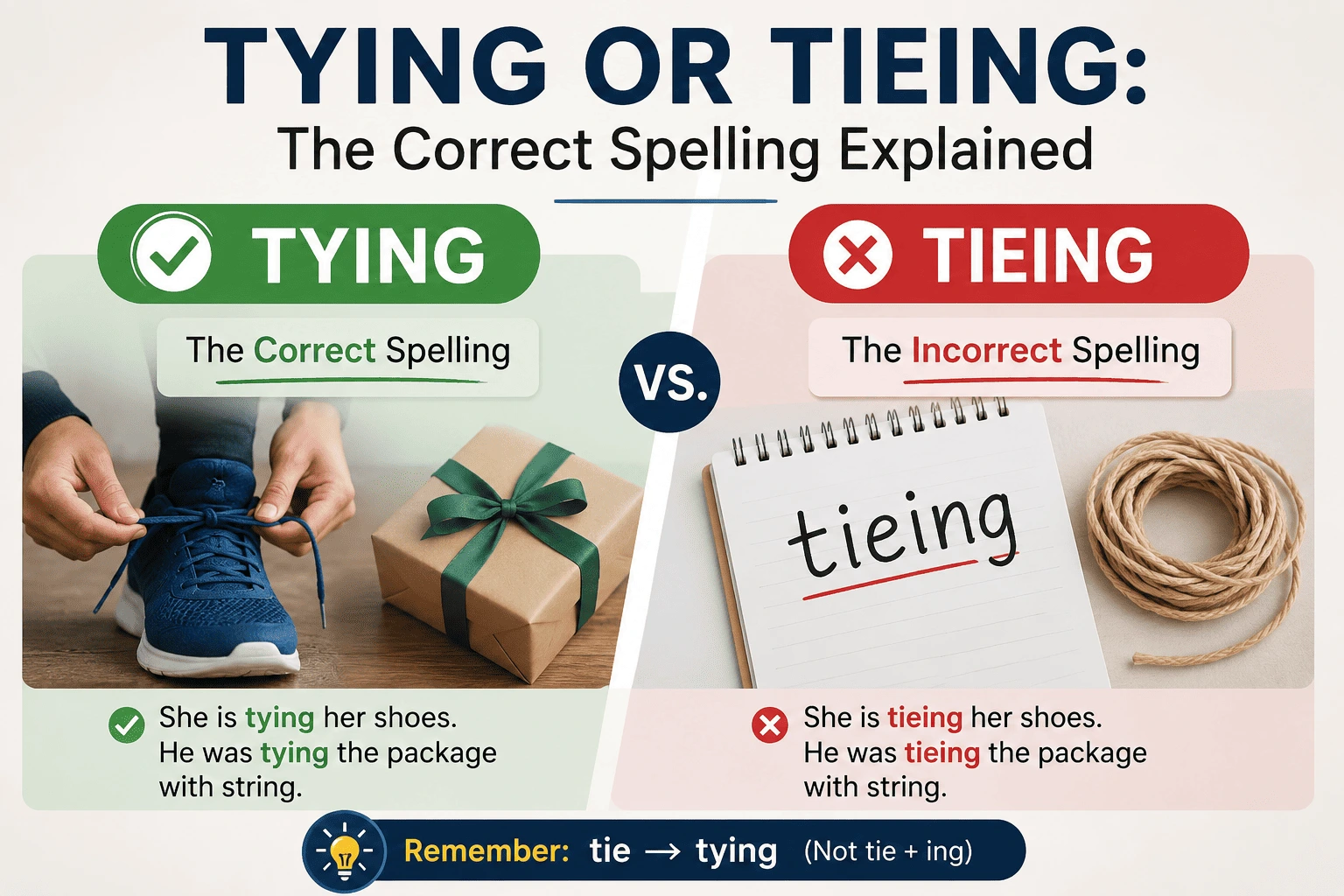
When you add -ing to tie, the spelling changes to tying. That can look a little odd at first, especially because writing tieing seems like the obvious way to build the word.
The standard spelling is tying. The difference comes from how tie changes when it takes the -ing ending.
Is It Tying or Tieing?
Tying is the standard spelling. Tieing is not the standard modern spelling.
Why Is “Tying” the Correct Spelling?
For the standard spelling, tie changes to tying when -ing is added. When -ing is added, the standard form of “tie” is “tying”.
The spelling does not simply keep tie and add -ing. That is why treating it as “tie + ing” leads to the wrong form.
A useful way to remember it is simply to keep tie → tying together rather than trying to build the word letter by letter.
Tying vs. Tieing in Real Sentences
Tying is the form you use in ordinary sentences:
- She is tying her shoes.
- He was tying the package with string.
- They spent the afternoon tying ribbons around the boxes.
If you write tieing in these sentences, the spelling is incorrect.
Adding -ing to “Tie”
The spelling of tie can be misleading if you treat every word ending in e the same way. English spelling changes with the word and the ending being added, so the visible pattern alone is not always enough.
Frequently Asked Questions
Is tying or tieing correct?
Tying is the standard spelling. Tieing is not the standard form.
Why is tieing considered incorrect?
Because the standard -ing form of tie is spelled tying, not tieing.
Does tie become tying when adding -ing?
Yes. The spelling changes from tie to tying.
What happens to the final e in tie?
The final e is not kept in the spelling of tying.
Can tieing ever be used as the standard spelling?
No. Tying is the standard spelling.
What is an easy way to remember tying?
Remember the pair tie → tying rather than building the word as tie + ing.