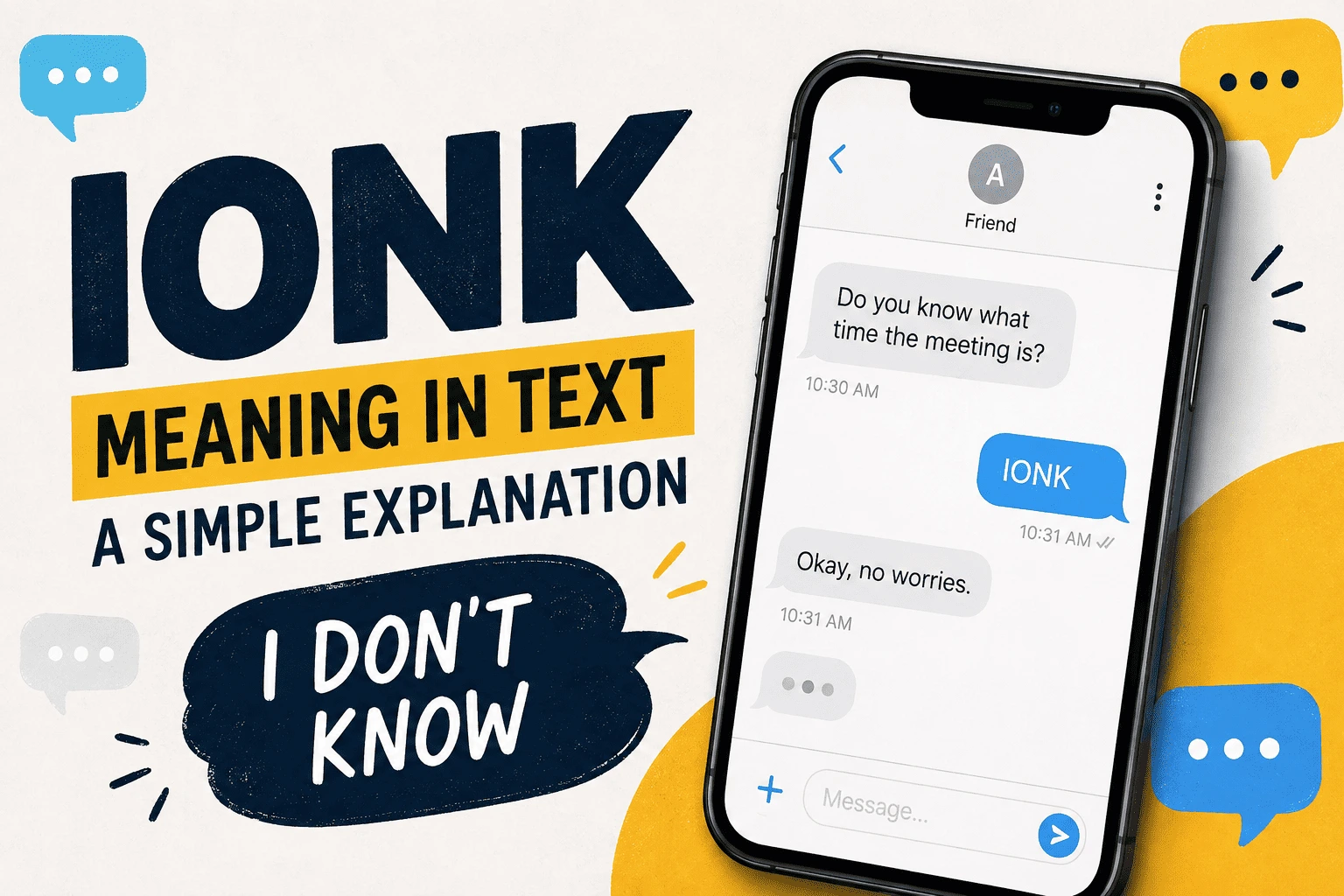
If you saw “IONK” in a text or comment, the first question is pretty simple: what was the person trying to say?
IONK is generally used as an informal way of saying “I don’t know.” It shows up in casual messages where people are typing quickly and aren’t concerned with standard wording. The exact feel can depend on the surrounding message, so a short reply and a longer sentence may not come across in the same way.
Context helps make the meaning clearer. Once you look at how IONK is being used in the conversation, the context can help you work out what the person means, whether the person simply doesn’t know, is unsure, or is being casual about the answer.
What Does IONK Mean in Text?
In texting, IONK usually means “I don’t know.” It is an informal slang form used to express uncertainty or say that someone does not have an answer.
IONK is less standardized than “IDK,” and its usage can vary. IONK can be described as a stylized form of “I don’t know,” although other interpretations have also been reported, so the surrounding sentence matters when the meaning is unclear.
People use it because typing “I don’t know” can feel more formal than typing “I don’t know” in a casual chat. IONK can appear in quick, casual messages.
For example:
“IONK what time they’re getting here.”
Here, the person doesn’t know what time they’re arriving.
How IONK Is Used in Real Text Conversations
The words around IONK can change how the reply comes across. If someone replies with IONK after a direct question, it can simply mean they do not have the answer. If it appears as part of a longer sentence, the words around it can show what the person means.
For example, someone might reply, “IONK, I’ll have to check.” A short “IONK” by itself can feel more abrupt.
A casual comment may use IONK without much thought, while a reply in an argument can come across as dismissive. Punctuation and the words added around it can change that feel without changing the basic meaning.
IONK vs. Similar Texting Abbreviations
IONK is easy to confuse with IDK, mainly because both can appear when someone does not have an answer. They are not necessarily interchangeable in every message, though.
IDK is the familiar abbreviation for “I don’t know.” IONK can be used similarly, but its usage is less standardized. Swapping IONK and IDK may change how a message sounds even when both are being used to express uncertainty.
Reading the whole sentence can help show whether IONK or IDK fits the intended meaning. If another abbreviation looks similar but does not fit the sentence, the surrounding words can help clarify the meaning.
Can IONK Sound Rude or Dismissive?
IONK does not automatically sound rude. In a relaxed conversation, it can come across as a quick, casual response. The same reply can feel dismissive if someone is asking a serious question and gets only “IONK” in return.
The relationship between the people matters, too. Friends may read a short reply differently than coworkers or someone they barely know. Added words can make the response feel less abrupt, while punctuation can sometimes make a short message feel sharper.
IONK may feel out of place in formal communication. It belongs more naturally in casual texting, comments, and informal conversations.
When You’re Still Unsure What IONK Means
Start with the words immediately around it. A sentence can make the intended meaning obvious even when the abbreviation itself is unfamiliar.
The type of conversation helps, too. A casual chat, sarcastic exchange, serious discussion, or argument can give the same short reply a different feel. If the person has a consistent way of texting, that person’s usual texting style can help too.
When the meaning actually matters, asking the sender is better than building a whole interpretation around one abbreviation.
1 thought on “IONK Meaning in Text: A Simple Explanation”