“Exception spoofer” is not a standard term with one fixed meaning across software. You may see it in programming, debugging, security, or system-related discussions, but the thing being described can vary quite a bit. The name alone does not tell you exactly what the tool or mechanism does.
The important distinction is between exception handling and exception spoofing. Exception handling is about dealing with an error or unexpected condition in a controlled way. Spoofing, in this context, is closer to changing, imitating, or representing expected behavior. An exception spoofer may therefore affect how exception behavior is seen or handled rather than simply fixing the exception itself.
The term makes more sense once two basic ideas are clear: what an exception represents and what spoofing means. From there, “exception spoofer” can be understood as a general description for something that modifies, intercepts, simulates, or otherwise represents exception behavior in a particular software environment.
That environment matters. A mechanism working inside an application is not necessarily doing the same thing as one working at the runtime or system level. So an exception spoofer should not be treated as a universal software category with one standard implementation.
What Is the Basic Meaning of an Exception Spoofer?
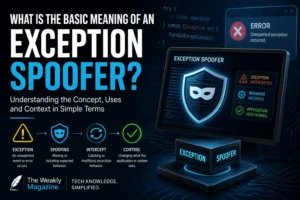
An exception is an event that tells software something did not proceed as expected. In ordinary programming, this might happen when an operation cannot be completed, an input is invalid, or some required resource is unavailable. The program can then catch the exception, log it, handle it, or let it continue through the normal exception process.
Spoofing has a different idea behind it. To spoof something generally means to make software see an expected signal, identity, value, or behavior in a form that has been altered or imitated. The exact meaning depends on what is being spoofed.
Put those ideas together, and an “exception spoofer” can refer to a mechanism that changes how exception behavior is produced, intercepted, represented, or observed. That does not automatically mean it creates fake errors, hides every error, or works outside the application. Those are implementation details.
For example, an actual exception might originate from a failed operation inside an application. A separate mechanism could intercept that behavior and cause the application to receive or observe a different result. The original exception still matters; changing what happens around it does not necessarily remove the underlying fault.
This is why the term needs context. One implementation may operate within an application, while another may interact with a runtime or another software layer. The name “exception spoofer” by itself is not enough to establish which one is being discussed.
What Is the Difference Between Exception Spoofing and Normal Exception Handling?
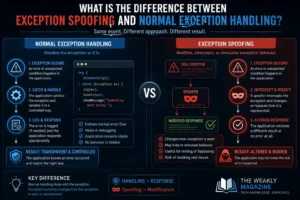
Normal exception handling stays within the application’s expected error-handling path. A developer detects an unexpected condition, catches the exception when appropriate, records useful information, and decides what the application should do next. The goal is controlled behavior rather than changing what the exception represents.
Exception spoofing or related modification is different because the focus can be on the exception behavior itself. Instead of simply deciding how to respond to an exception, a mechanism may intercept, modify, suppress, or simulate behavior around that exception. The exact distinction depends on where the change occurs and what the mechanism is intended to affect.
Catching, logging, suppressing, modifying, intercepting, and simulating are not interchangeable terms. Logging an exception does not change it. Catching one does not necessarily suppress it. Intercepting behavior can happen before the application handles the exception, while simulation may create a condition for testing without the same underlying failure occurring naturally.
A normal exception handler and an externally applied modification can therefore be solving different problems. The handler is part of the application’s own response to an error. The modification may be concerned with changing what the application observes or how that behavior is presented to another software layer.
Suppressing an exception is not automatically an improvement, either. An exception may contain useful information about what actually went wrong. If that information disappears, the visible symptom might change while diagnosing the real problem becomes harder.
How Can an Exception Spoofer Work?
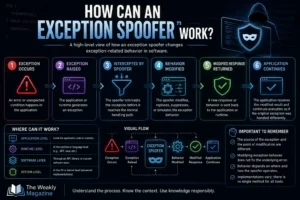
At a high level, the process can be thought of as an exception being generated, a relevant software layer observing or intercepting the behavior, and some defined response being applied afterward. That response might alter what the application or another layer sees.
Where this happens depends on the implementation. A mechanism may operate at the application level, interact with a runtime, work through another software layer, or have system-level involvement. The label “exception spoofer” does not establish the layer by itself.
The source of an exception and the point where its behavior is modified are also two different things. An error can originate inside an application, while a separate mechanism changes what happens when that error reaches a particular part of the software stack.
That distinction matters when judging what the mechanism actually accomplishes. Intercepting or changing exception behavior is not the same as fixing the operation that caused the exception. The application may appear to behave differently while the underlying fault remains.
Because implementations vary, there is no single technical sequence that applies to every tool or system described as an exception spoofer.
What Are the Possible Uses of an Exception Spoofer?
Testing is one of the clearer reasons to modify exception behavior. A development environment may need a controlled failure condition so that an application’s response can be checked without waiting for the same problem to occur naturally. This can also help when a developer wants to see what the application does when a particular exception condition is present.
Debugging and compatibility work can involve similar behavior. If an application reacts differently across runtimes, operating systems, or software versions, observing or modifying exception behavior can help isolate where that difference appears. The same idea can be useful in software analysis when the question is how an application responds to a particular condition rather than why the condition originally occurred.
Those are different from using exception-related modification to interfere with security controls, anti-cheat systems, or application restrictions. The underlying concept may look similar, but the purpose and authorization are not. A controlled test performed by a developer is not the same situation as changing software behavior to get around a restriction.
What Can “Exception Spoofer” Mean in a Gaming and Anti-Cheat Context?
Gaming discussions make the term harder to pin down because “spoofer” is often used loosely for tools associated with identity changes or detection avoidance. That does not mean an exception spoofer is automatically a gaming-specific tool, or that it changes a particular game identifier.
Anti-cheat systems monitor software and system behavior to detect activity that falls outside the game’s expected environment. Exception-related modification can affect software behavior, but that is fundamentally different from changing a hardware identifier. An HWID spoofer is concerned with hardware identity; an exception spoofer, when the term is used in this sense, concerns exception-related behavior.
The two labels can therefore appear together in gaming discussions without describing the same mechanism. Claims about what a particular game, anti-cheat system, or tool will detect need to be tied to that specific implementation rather than assumed from the word “spoofer” alone.
For troubleshooting or authorized testing, exception-related behavior can be examined as part of understanding a software problem. Using similar techniques to bypass an anti-cheat system or another application restriction is a different context, and the relevant authorization and platform rules matter.
What Does the Reliability of an Exception Spoofer Depend On?
Reliability can change with the operating system and system architecture. A mechanism that works on one Windows version may behave differently after an update, especially if it depends on software layers that have changed underneath it. The target application or runtime can introduce the same problem through its own updates.
Maintenance matters too. A tool that is no longer maintained may stop working when the surrounding software changes, even if it worked reliably before. Security software, integrity checks, and other system protections can also interfere with exception-related behavior.
There is a difference between a temporary change and one that persists across restarts or system changes. A temporary modification may disappear when the relevant process ends, while a persistent change can create a different set of compatibility and recovery concerns.
Claims such as “undetected,” “stable,” or “works everywhere” need some context behind them. Without knowing the operating system, target software, version, and conditions under which the claim was tested, those labels do not say much about actual reliability.
What Should You Understand Before Using an Exception Spoofer?
Start with the actual problem rather than the tool name. An exception may be the visible symptom of an application bug, a compatibility problem, outdated software, or detection-related behavior. Changing exception behavior will not necessarily address whichever of those is actually responsible.
The tool’s purpose and supported environment should be clear before assuming it is relevant. If ordinary debugging or exception handling already produces the required result, adding another mechanism may not solve anything useful.
System-level tools deserve more caution because instability, compatibility problems, privacy concerns, or security conflicts can extend beyond the application itself. Important data and system configuration should have a recovery or rollback option before making changes that may be difficult to undo.
Claims that a tool is a universal solution, a permanent fix, or guaranteed to remain undetectable are especially difficult to take at face value without specific evidence. The useful question is whether the proposed behavior change matches the problem that actually needs to be solved.
When Can an Exception Spoofer Be Useful, and When Is It Not?
An exception spoofer can make sense in controlled testing, debugging, research, or software analysis when changing exception-related behavior helps answer a specific question. The value comes from what that change lets you investigate, not from the label attached to the tool.
If normal exception handling already gives the application the behavior it needs, there may be little reason to add another mechanism. The same applies when the real problem is a bug, corrupted installation, outdated software, or compatibility issue. In those situations, a spoofer may only hide or work around the symptom without addressing what caused it.
The context changes when the goal is to bypass a security or anti-cheat restriction. That is no longer simply a debugging decision. Authorization and the rules of the relevant platform or application need to be considered.
The better question is whether the behavior being changed matches the problem you are actually trying to solve.
Frequently Asked Questions
What is an exception spoofer?
“Exception spoofer” is a context-dependent term for a mechanism that may alter, intercept, simulate, or otherwise change how exception-related behavior is represented or observed. It does not have one universal implementation.
Is an exception spoofer the same as an exception handler?
No. An exception handler is part of normal application error handling. An exception spoofer may modify or represent exception behavior instead of simply deciding how the application responds to an exception.
How is an exception spoofer different from an HWID spoofer?
An HWID spoofer concerns hardware identity. An exception spoofer, when the term is used in this sense, concerns exception-related behavior. They should not be treated as the same type of mechanism just because both use the word “spoofer.”
Can an exception spoofer fix the underlying error?
Not necessarily. Changing the behavior associated with an exception does not automatically repair the operation, application bug, or system condition that caused it.
Does every exception spoofer work at the system level?
No. The implementation may operate at the application level, runtime level, system level, or another software layer. The term itself does not establish where it operates.
Why can an exception spoofer behave differently after a software or Windows update?
Updates can change the application, runtime, operating system, or other software layers that the mechanism depends on. A change in any of those layers can affect compatibility or behavior.
Is “exception spoofer” a standard technical term with one universal definition?
No. The meaning depends on the software environment and the specific implementation being discussed.
What to Keep in Mind About Exception Spoofers
“Exception spoofer” is better understood as a context-dependent term than as a universal product category. The same label can point to different behavior depending on the implementation and environment.
The useful distinctions are already fairly simple: exception handling deals with handling exceptions, spoofing concerns altered or represented behavior, and the underlying problem may still exist after that behavior changes.
A tool’s usefulness depends on its actual implementation, target environment, and intended purpose. The name alone does not tell you whether changing exception behavior is the right answer to the problem in front of you.