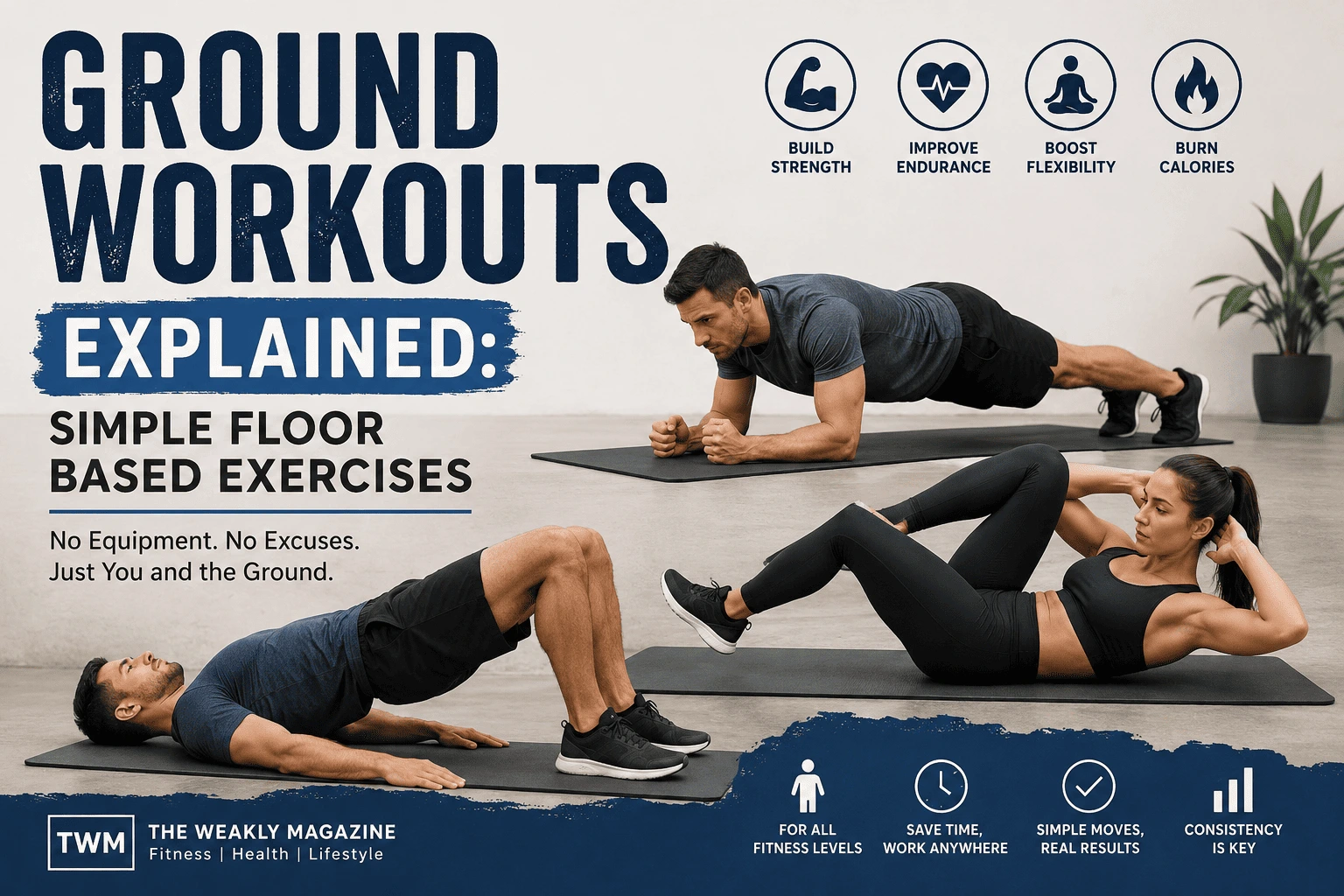
Ground workouts can mean more than simply doing exercises on the floor. The term can include bodyweight movements performed from the ground, floor-based strength work, and exercises that move between standing and floor positions.
For a beginner, the harder part is usually choosing where to start. A long list of exercises does not tell you which movements belong together, how much to do, or when a movement has become too easy or too difficult.
This guide focuses on useful ground movements for strength, core control, mobility, and general fitness. It does not depend on a specific program or a room full of equipment. Form, manageable progression, rest, and regular practice matter more than making every session as intense as possible.
What Are Ground Workouts and What Makes Them Different?
A ground workout is built around movements performed on or close to the floor. Some stay there for most of the exercise, such as a glute bridge or plank. Others, such as squats, begin from a standing position but can still fit into a routine built around getting down to the ground and back up.
The term also overlaps with bodyweight training, but they are not quite the same thing. Bodyweight training describes how resistance is provided; ground workouts describe where and how the movements are performed. A push-up is bodyweight training and a ground-based exercise at the same time, while a standing bodyweight squat is bodyweight training without being a floor exercise.
Because ground workouts can be fairly simple to set up. A clear patch of floor may be enough for many movements, and difficulty can often be changed by using an easier variation, changing the range of motion, or controlling the movement more carefully.
There is also no rule that a ground workout has to leave you exhausted to be useful. A controlled set that you can repeat with solid form has a practical place in a beginner routine.
The Basic Movement Patterns to Learn First
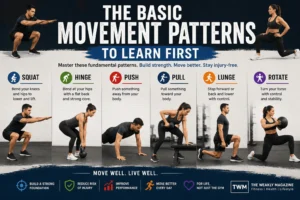
A useful ground workout does not need a long exercise list. It needs a few movement areas that cover different parts of the body without asking the same muscles to do all the work.
For the lower body, the basic choices include movements such as squats and glute bridges. Push-ups cover the main upper-body pushing pattern, while planks and controlled abdominal movements add core work. Floor-based leg movements can add hip and leg control, and movements such as the Superman bring some attention to the back and posterior chain.
Mobility movements help you work through a comfortable range of motion rather than focusing on strength.A mobility movement focuses on comfortable range of motion rather than strength. It is there to help you move through a comfortable range of motion and prepare the body for movement.
Lower-Body Ground Exercises
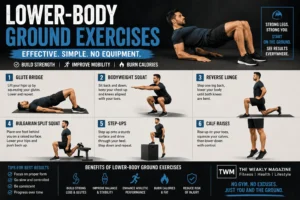
Glute bridges are a straightforward way to train the hips and glutes from the floor. The useful part is not lifting the hips as high as possible. It is keeping the movement controlled rather than rushing through the repetitions.
Floor-based leg movements work in much the same way. Slow movement and a range of motion you can control usually tell you more than trying to make every repetition bigger or faster.
Squats can still have a place in a ground workout when standing movements are part of the routine. They give the lower body a different demand from floor-based work, so they do not need to be treated as interchangeable with glute bridges.
For a beginner, an exercise can be made easier by using a simpler variation or reducing the amount of work. The goal is to keep the movement manageable enough that form does not fall apart halfway through the set.
Upper-Body and Core Exercises
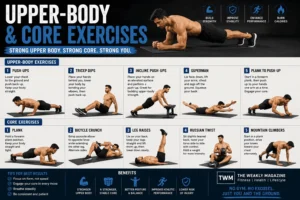
Push-ups give the routine a clear upper-body strength movement. If a standard push-up is too difficult, a modified version can reduce the demand without removing the basic movement.
Planks are less about holding on for as long as possible and more about keeping the body stable. Once the position starts to break down, adding more time does not add much value.
Bicycle crunches, leg raises, and similar exercises can add controlled abdominal work. They are not automatically better because they create more fatigue. A ground routine also needs room for the rest of the body, rather than turning into a collection of ab exercises.
How to Build a Simple Ground Workout
Once the movement areas are clear, putting them together is fairly simple. A beginner does not need a dozen exercises in one session. A lower-body movement, an upper-body movement, and some core work can give the routine a reasonable starting structure.
Repetitions make sense for some movements, while timed holds work better for others. Rest between sets is part of the workout, not something that means the session has gone wrong. Exercises can also be done one at a time with rest between them, or arranged as a circuit if that format suits the person doing the workout.
Difficulty can be adjusted without rebuilding the whole routine. A few more repetitions, a longer hold, or a harder variation can change the demand without changing everything at once.
A Beginner-Friendly Example
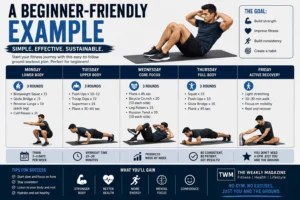
A simple starting combination could use glute bridges, modified push-ups, a plank, and one controlled leg exercise. Choose a number of repetitions or a hold time that you can complete without losing control.
Rest between sets can be short or longer depending on how demanding the movement feels. If form starts slipping, reducing the repetitions or returning to an easier variation is a better adjustment than forcing the set to continue.
How to Progress Without Making the Workout Complicated
Progress does not have to mean turning a short workout into a hard one. A better starting point is to keep the movement steady and make one small change when the current version feels manageable.
That change might be a few more repetitions, a slightly longer hold, or a move from an easier variation to the standard version. There is no need to change everything at once. If form starts falling apart, the workout has probably moved ahead of the movement rather than the other way around.
Speed and exhaustion are not reliable measures of progress. A slower, controlled version of an exercise can be more useful than rushing through extra repetitions just to make a session feel harder.
Recovery matters here too. If the routine keeps getting harder while the body never gets enough time to recover, adding more work stops being useful. Consistency gives those gradual changes somewhere to build.
When Ground Workouts Work Well—and When to Adjust Them
Ground workouts fit easily into a home routine because they can work in a small amount of space and do not depend on a full set of equipment. That makes them practical for someone who wants a straightforward way to train without building an elaborate setup.
They also have limits. A basic ground workout can support general strength, core control, mobility, and fitness, but someone training for a specific sport or a particular strength or endurance goal may need to adjust the routine around that goal.
The same applies when a movement does not suit someone’s current mobility or physical limitations. Existing pain or an exercise restriction is a reason to stop and reconsider the movement rather than forcing it because it appears in a routine.
Ground workouts are useful as one part of an active routine. They do not need to carry the whole burden of fitness on their own.
Common Ground Workout Mistakes That Reduce Their Value
A ground workout can lose its usefulness without being technically “wrong.” Doing more exercises, more repetitions, or harder variations is not automatically better if the movement becomes sloppy or the routine becomes difficult to repeat.
Choosing a variation that is far beyond your current level can create the same problem. If you cannot control the movement, making it harder only adds difficulty without much benefit. The same goes for treating every session like a test of maximum effort. Recovery is part of being able to train again.
Core exercises are another place where people often rush. Moving faster can make a set feel harder, but it does not make poor control a good substitute for solid movement.
A routine can also become too complicated to use consistently. If every workout requires a long list of exercises, constant adjustments, and complicated scheduling, the plan may be the problem rather than the lack of effort.
Frequently Asked Questions
Are ground workouts suitable for beginners?
Yes. Ground workouts can be suitable for beginners because many movements can be modified to match a beginner’s current ability.
Do ground workouts require equipment?
Not necessarily. Many ground-based movements can be done with little or no equipment, although equipment can be added later if a particular goal calls for it.
How long should a ground workout be?
A beginner can use a manageable session length that leaves enough time for the planned movements and recovery. A beginner can start with a manageable session and adjust the length based on the number of movements, rest periods, and ability to recover without making the workout unnecessarily long.
Can floor-based exercises improve strength?
Yes, especially for beginners and for movements where bodyweight provides enough resistance to create a Bodyweight can provide enough resistance to make the exercise demanding. As someone becomes stronger, the exercise variation or overall training approach may need to change to keep providing an appropriate challenge.
What if push-ups or planks are too difficult?
Use an easier variation rather than forcing the standard movement. The goal is to keep enough control to perform the exercise properly, then gradually work toward a more demanding version.
How often can I repeat a ground workout?
That depends on the workout’s difficulty and how well you recover between sessions. Repeating a manageable routine consistently is more useful than making each session so demanding that the next one becomes difficult to complete.
Can ground workouts be combined with walking or other physical activities?
Yes. Ground workouts can sit alongside walking and other forms of physical activity. The overall routine should still leave enough room for recovery rather than treating every activity as another hard workout.
Final Thoughts
Ground workouts do not need a long exercise list to be useful. A manageable routine performed with control gives you a better place to start than constantly chasing harder movements or longer sessions.
For a beginner, the sensible order is simple: get comfortable with the movement, keep the form steady, then increase the difficulty when the current level becomes manageable. Strength, core control, and mobility can develop within that process without turning every workout into a test of intensity.
The routine that matters is the one you can perform safely and keep doing.
1 thought on “Ground Workouts Explained: Simple Floor Based Exercises”