You can know the number and still have no real sense of the distance. One hundred feet (How Far Is 100 Feet) is easy to write down, but harder to picture until you compare it with something familiar.
Start With the Exact Size of 100 Feet
One hundred feet is exactly 30.48 meters. In yards, it is 33⅓ yards. That puts it a little over the length of a standard 30-yard stretch, but well below 100 meters.
The unit matters because 100 feet and 100 meters sound similar while being very different distances. One hundred meters is more than three times as long as 100 feet.
Imagine 30 one-meter segments laid end to end. You would still need another 48 centimeters to reach the full 100 feet.
In miles, 100 feet is only about 0.0189 miles, so thinking in miles is not especially useful for a distance this short. Feet, yards, or meters give you a better feel for the scale.
What 100 Feet Looks Like When You Are Standing Next to It
A person standing beside a 100-foot structure would look small by comparison. Even someone around 6 feet tall would need to be imagined many times over to reach that height, which is why 100 feet feels very different when you look up instead of across the ground.
A building around 10 stories can help you picture the vertical scale. It is only a rough comparison because floor heights vary, but it puts 100 feet well beyond the scale of an ordinary house or small commercial building.
There is also a useful distinction between 100 feet long and 100 feet tall. A 100-foot distance across the ground can feel manageable when you are looking straight ahead. Put that same distance upward and the scale becomes much more dramatic.
If you stood at one end of a 100-foot stretch and looked toward the other end, you would be judging a fairly substantial distance, but still one that fits comfortably into an everyday outdoor setting.
Familiar Things That Make 100 Feet Easier to Picture

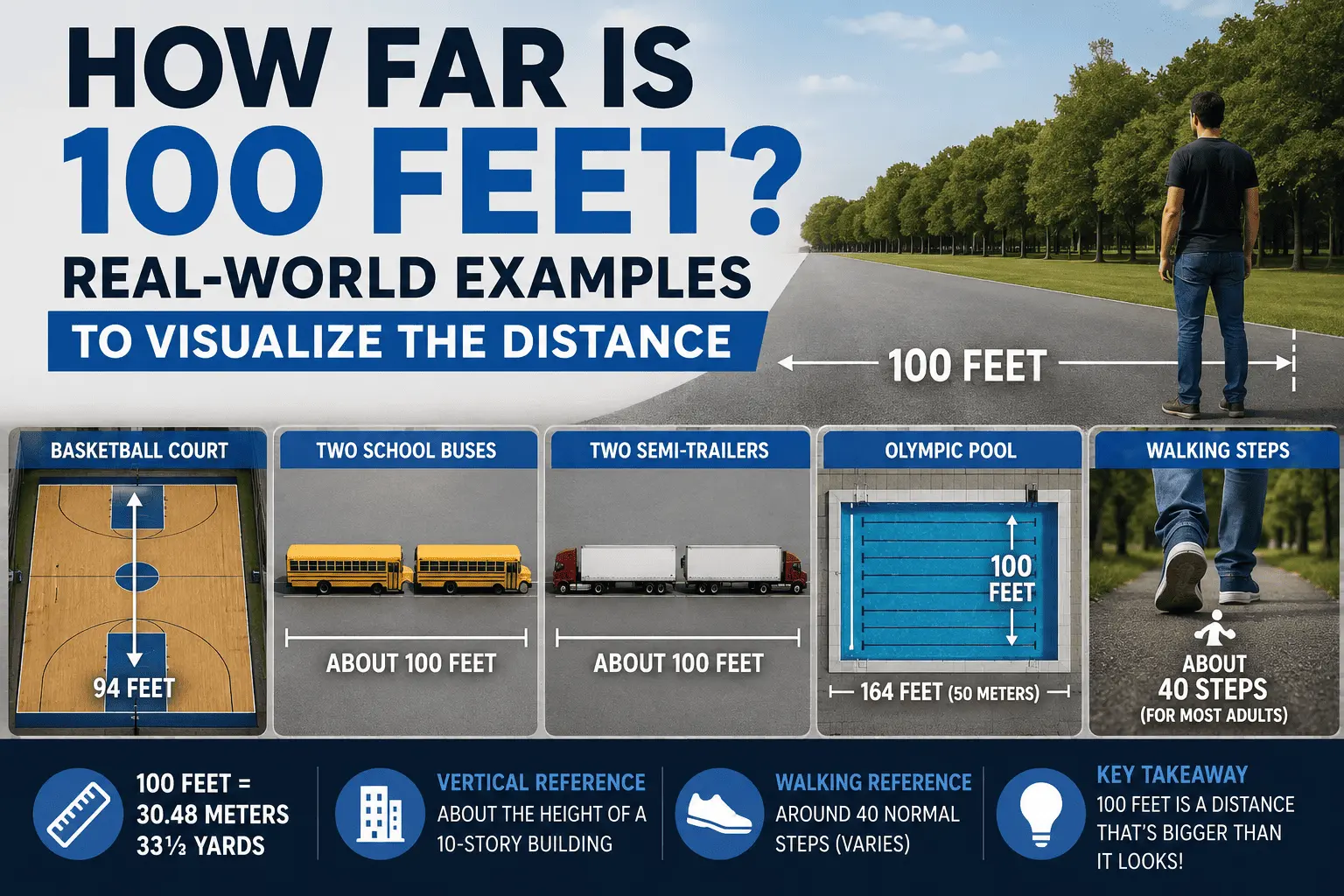
A standard basketball court is one of the easier references for this distance. An NBA court is 94 feet long, so 100 feet is just a little longer than the playing surface from one baseline to the other.
Two school buses placed end to end can also get you into the right ballpark, although bus lengths vary. Two semi-trailers give another vehicle comparison. The exact number matters less here than seeing how much ground 100 feet occupies when large objects are lined up.
An Olympic swimming pool is another reference. Its standard length is 50 meters, so 100 feet is considerably shorter than the full pool. Its width, however, is much closer to the scale you are trying to picture.
A long tug-of-war rope can make the same idea easier to grasp because it gives you one continuous line rather than several separate objects. A large tree can work for the vertical sense too, but its height can vary so much that it should be treated as a rough reference rather than a fixed measurement.
How Far is 100 Feet Without a Measuring Tape
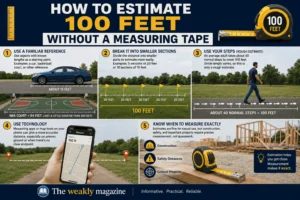
If you already have a familiar reference nearby, estimating 100 feet gets easier. A vehicle, sports-court dimension, or another object with a known length can give you a starting point. You can also break the distance into smaller pieces, such as five 20-foot sections or ten 10-foot sections, rather than trying to judge the whole stretch at once.
Walking steps are another rough option. A normal adult might cover 100 feet in roughly 40 steps, but stride length varies, so this is only a field estimate. It is not something to rely on when the distance needs to be exact.
A measuring app or mapped distance can be more useful than guessing. That matters when there is no obvious endpoint, the ground is uneven, or the distance is being used for something where a few feet make a difference.
An estimate is usually enough for everyday use. Construction, safety-related distances, or other situations that require a defined measurement call for an actual measurement rather than visual judgment.
Common Mistakes People Make When Visualizing 100 Feet

One easy mistake is mixing up feet and meters. The numbers look similar enough that the difference can slip past you, but 100 meters is more than three times 100 feet.
The same problem comes up with familiar objects. A 10-story building is not automatically 100 feet tall, and buses, trailers, and other vehicles do not all have identical dimensions. The basketball court comparison is useful because an NBA court is 94 feet long, but that does not make every basketball court exactly 94 feet.
Walking steps are also easy to over trust. Two people can take noticeably different numbers of steps across the same 100-foot distance.
Perspective can throw off a visual estimate, too. A clear, open 100-foot stretch may look shorter than a crowded or uneven space of the same length. Using more than one reference can help you avoid putting too much weight on a single comparison.
Quick Ways to Remember What 100 Feet Feels Like

Think of 100 feet as about 30.5 meters. For a horizontal reference, an NBA basketball court is 94 feet long, so 100 feet is just a little farther.
For height, a 100-foot structure is roughly in the range of a 10-story building, although actual building heights vary. For a ground-level comparison, picture two large vehicles lined up end to end.
Walking can give you another rough sense of the distance: around 40 normal steps for many adults, with plenty of variation from person to person.