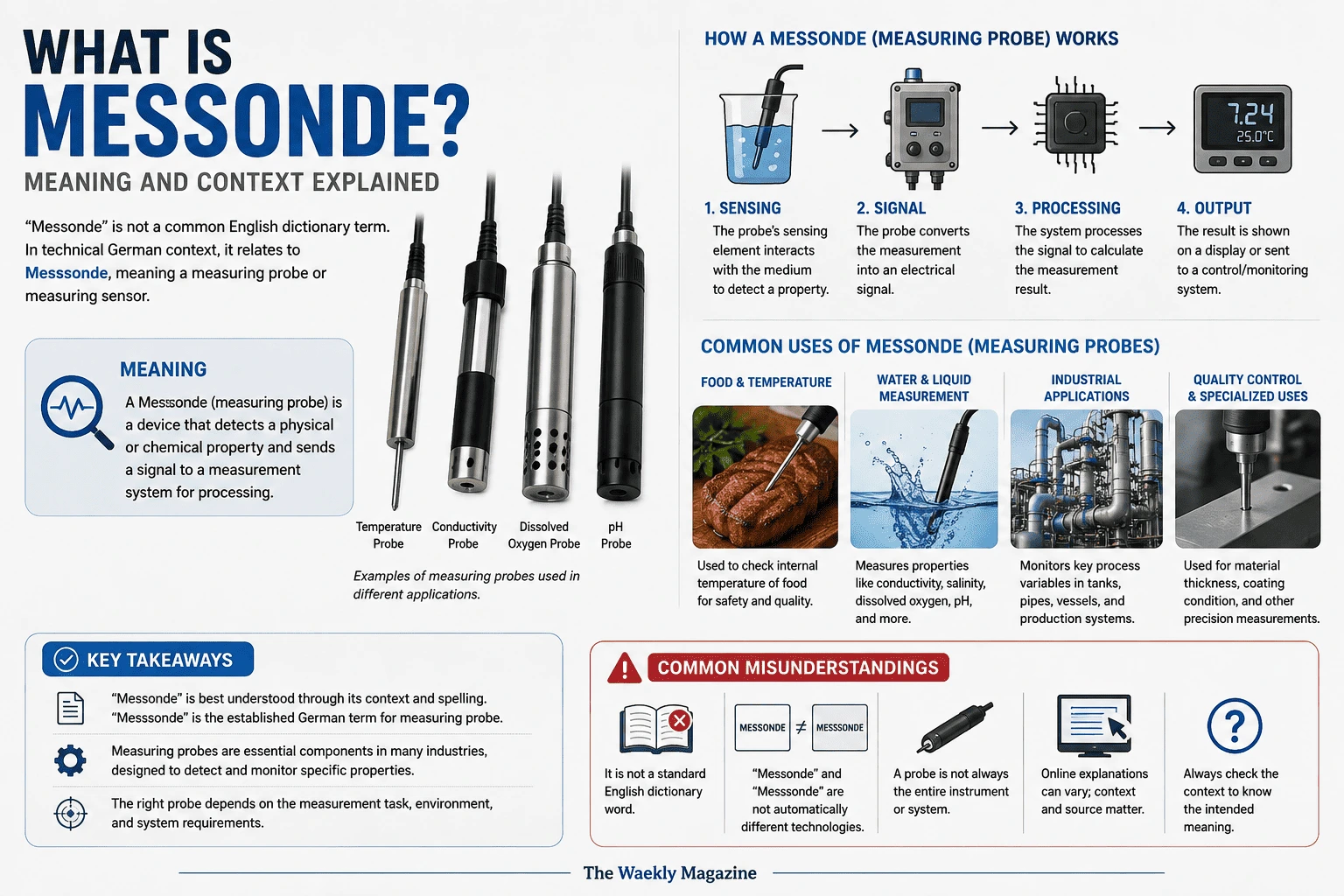
“Messonde” is not a common English dictionary term, so the spelling alone does not give you a reliable definition. The word can appear in different online contexts, which makes it risky to assign one meaning without checking where it came from.
One useful technical interpretation points to the German term “Messsonde.” German-English dictionaries translate Messsonde as “measuring probe,” “test probe,” and, in some technical contexts, “measuring sensor.”
The spelling matters here. “Messonde” and “Messsonde” are not interchangeable spellings that should automatically be treated as the same established English word. Messsonde is the documented German technical term.
For that reason, the intended meaning depends on how the person, document, product, or source uses the term.
What Does “Messonde” Actually Mean?
If “Messonde” appears in a technical setting, the closest established reference is the German Messsonde, which means a measuring probe. German terminology sources also connect Messsonde with terms such as probe and measuring sensor.
A measuring probe is a component of a measurement setup that interacts with what is being measured. Depending on the equipment, it can detect a physical or chemical property and provide a signal that the rest of the system can use. The exact design depends on the measurement involved.
That does not make every appearance of “Messonde” a technical term. The spelling by itself is too thin to establish that. If it appears in a translated manual, technical document, or equipment description, the Messsonde interpretation becomes more plausible. If it appears somewhere else, the surrounding context has to do more of the work.
Why the Spelling “Messonde” Can Be Confusing
The established German spelling is Messsonde. German technical dictionaries list Messsonde as ‘measuring probe”.
In the German term Messsonde, the spelling reflects its compound form. Sonde is itself a German technical noun used for a probe or sensor, while Messsonde specifies the measurement context.
“Messonde” can still show up in online material, but the shorter spelling does not, by itself, establish a separate device or technology. When the surrounding material is technical, comparing the spelling with Messsonde is usually the more useful way to understand what was intended.
The terms overlap in technical use, but they are not a reason to treat every variation of the word “Messonde” as a different concept.
How a Messonde or Measuring Probe Works
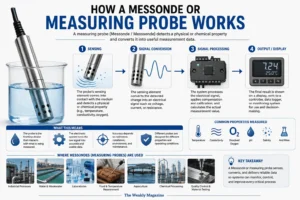
A measuring probe has a sensing element that responds to whatever property the equipment is designed to measure. The response might involve temperature, electrical conductivity, oxygen, or another measurable characteristic.
The final reading may involve more than the sensing element alone. A measurement system receives and processes its signal, then presents the result in a usable form. In industrial equipment, the probe may be connected to a transmitter or analyzer rather than a simple display. Oxygen measurement systems, for example, can process a sensor signal into oxygen concentration or saturation values.
The accuracy of that result depends on more than the probe alone. Calibration, installation, operating conditions, and whether the probe is compatible with the material being measured can all matter. For conductivity sensors, for instance, manufacturers consider factors such as measurement range, process temperature, and the chemical makeup of the process when selecting a probe.
The design changes with the job. A probe intended for one property may use a very different sensing method from one intended for another, even when both are simply described as measuring probes.
Where Measuring Probes Are Commonly Used
Measuring probes show up wherever a system needs a reading from something that cannot be measured reliably from a distance or from the main instrument alone.
Temperature probes are used in food, laboratory, and industrial settings. A food probe, for example, needs to reach the part of the food whose temperature matters, while the probe itself has to suit the conditions in which it is being used.
Water and liquid systems use specialized probes for properties such as conductivity, salinity, and dissolved oxygen. These are not interchangeable measurements. A field probe can combine several sensing elements for conductivity, temperature, and dissolved oxygen, while remaining connected to a separate handheld instrument.
Industrial setups can use probes inside tanks, pipes, vessels, or process equipment. The particular design depends on what needs to be measured and what the probe will encounter. Chemical compatibility, temperature, installation conditions, and the required measurement range can all affect the choice.
Temperature and Food Measurement
Food measurement is one of the more straightforward uses for a probe. A probe can check the internal or core temperature of food rather than relying only on the temperature at its surface. That matters when the inside of a product heats differently from the outside.
Placement can affect the reading. The probe needs to reach the part of the food that actually needs to be checked, and contact with a pan, tray, or another surface can distort the result. Food-contact probes also need materials and designs that can be cleaned properly and used hygienically.
Water, Conductivity, and Oxygen Measurement
Water and other liquids require different sensing approaches depending on what needs to be measured. Conductivity probes, for example, can help assess how readily a liquid carries an electrical current, which can also be used in related measurements such as salinity. Oxygen measurements use specialized sensing methods rather than simply applying the same setup used for temperature.
These probes are used in settings such as water-quality testing, laboratories, and industrial systems. Calibration and maintenance matter because the surrounding liquid, buildup on the sensing surface, and operating conditions can affect the reading.
Industrial Measurement and Quality Control
Industrial probes can be built for conditions that are much less forgiving than a simple temperature check. In tanks, vessels, and production processes, they may be used to monitor temperature, levels, material conditions, or other process variables.
Some probe systems are designed for more specific checks, including material thickness or coating condition. The right setup depends on what is being measured and where the measurement takes place.
Temperature, pressure, corrosion, the material being measured, and the installation environment can all affect which probe is suitable. A probe that works well in one process may not be appropriate for another.
Common Misunderstandings About Messonde
One common mistake is treating “Messonde” as a standard English dictionary word with one fixed definition. The spelling itself does not provide enough information to make that assumption.
It is also easy to read “Messonde” and “Messsonde” as two completely unrelated technical concepts. The spelling difference matters, but it does not by itself establish that a separate technology is involved.
A measuring probe is not necessarily the entire measuring instrument or system. The probe may provide the sensing part while other components handle the signal, display, or processing.
Online descriptions can create another problem. A detailed explanation can sound authoritative without proving that its interpretation is the one intended by the original source. The surrounding context still matters.
Without supporting context, those interpretations should not be treated as established meanings.
Frequently Asked Questions
Is “Messonde” an official English dictionary word?
“Messonde” does not appear to be a common standard English term. Its meaning depends on where the word came from and how it was spelled in the original source.
What is the difference between “Messonde” and “Messsonde”?
“Messsonde” is the more recognizable German technical form associated with a measuring probe. “Messonde” may be a shortened, altered, or otherwise context-dependent spelling, so the two should not automatically be treated as separate technologies.
What is a Messsonde used to measure?
A measuring probe can be designed to detect different physical or chemical properties. The actual measurement depends on the sensing element and the system it is connected to.
Is a measuring probe the same thing as a sensor?
Not necessarily. A probe often refers to the part placed where the measurement is taken, while a sensor can refer to the component that detects the property being measured. In real products, the terms can overlap.
Can one probe measure different types of physical or chemical properties?
Some probes are designed for more than one measurement, but this is not true of every probe. The sensing technology and instrument determine what a particular setup can measure.
Why does “Messonde” appear with different spellings online?
Spelling may change when a German technical term is shortened, copied, translated, or presented outside its original context. The surrounding information is more useful than the spelling alone.
How can you identify which meaning of “Messonde” is intended?
Check the spelling, the language of the source, and what the surrounding text says the term refers to. If the context is technical and points to measurement, Messsonde may be a relevant interpretation.
What to Keep in Mind
“Messonde” is best read through its context and spelling rather than treated as a fixed English word. In a technical German context, “Messsonde” refers to the idea of a measuring probe or sensing component.
Different measurement tasks require different probe designs and systems. When an online explanation gives “Messonde” a specific meaning, the source and surrounding context still matter before that interpretation is treated as established.